





Abstract
Academic Program Leaders (APL), including department chairs, associate deans, and deans, are essential to the successful development of fully online programs. However, APLs may lack academic training or direct experience with online instructional design, online pedagogy, online course quality assurance, and federal requirements for online/distance education. This paper describes the development of a training and resource course to help APLs be able to explain the course development process and the roles involved in online course development, articulate their responsibilities during online program planning process, identify specific ways that they can support the faculty subject matter experts and instructional designers in the course development process, evaluate an online template course for program alignment and discipline requirements and facilitate communication between the instructional design team and faculty teaching the course during deployment.
Introduction
When it comes to the development of courses for online programs, publications, presentations, and training tends to focus (rightly) upon the needs and responsibilities of faculty and instructional designers (ID). However, academic program leaders (APLs), including department chairs, associate deans, and deans, are also essential to the successful development of fully online programs. Their decisions and actions can have a positive or negative impact upon faculty, instructional designers, and students. This is especially true at our institution—a large midwestern public university—since the first point of contact for the development of fully online programs is between the APL and the Chief Online Learning Officer (COLO). The APL is the origin point, which means they play a critical role in tone-setting in this process—a role that they may not be trained for.
While APLs have responsibility for hiring, assignment teaching load, and evaluation of online faculty (McHaney & Spire, 2014), the rise of online learning in higher education has been accompanied by increased regulation (e.g., regular and substantive interaction) and concerns about student privacy, academic integrity, digital accessibility, student retention, and instructional quality, all of which are areas of concern to administrators (Dowd, 2026; Downs, 2022; Piña & Martindale, 2025).
During the COVID-19 pandemic crisis specifically, it became obvious that most faculty were ill-prepared for the switch to online learning and emergency remote teaching (Garrett, et al., 2020; Hodges, et al., 2020). Compared to faculty APLs have even fewer resources, literature, and training available to them regarding online education (Piña, 2023). Many APLs who are called to oversee online programs and courses may lack academic training or direct experience with online instructional design, online pedagogy, online course quality assurance, and federal requirements for online/distance education. They are often obligated to learn on-the-job, often with little or no training.
In this article, we describe how we have built a bridge between our Online and Extended Learning Unit and our institution’s APLs by creating a self-paced training and resource course designed specifically for academic leaders who oversee fully online programs at our institution. The course guides APLs through the process, knowledge base, and responsibilities for online program and course development.
Course Development Process
Piña (2021) described three models for online course development (Table 1 below).
Table 1: Models for Online Course Development
| Model | Characteristic |
| Autonomy | The faculty member is solely responsible for all course development (Hawkes & Coldeway, 2002) |
| Partnership | The faculty member partners with an instructional designer--the faculty member serving as the subject matter expert (SME) (Xu & Morris, 2007) |
| Team | The faculty member serves as SME with a design and development team that may include instructional designers and other technical design and development professionals (Hixon, 2008). |
Our Online and Extended Learning Unit has offered professional development programs to train and assist faculty in developing their own online courses. Data gathered from courses developed out of these programs indicated that it was not uncommon for a faculty member to take a year and a half to complete the development of an single online course. Further, although a Quality Matters course evaluation process was freely available to faculty, very few chose to have their courses evaluated, so there was no consistent quality assurance for online courses. Based on this context, the institution’s new strategic plan included goals for online program growth that would necessitate establishing the ability to develop online courses at scale and at a more consistent level of quality.
Due to staffing constraints, a team model for development was not feasible, so a partnership model was chosen, in which a faculty SME partners with an instructional designer. Our institution also chose to implement a master course model, where courses were built using a common design template to provide a common structure, navigation and layout (Aspillaga, 2016; Borgmenke, et al., 2013). A master course includes all content necessary within the course for a qualified faculty member to teach the course (Hill, 2012; Piña, 2021). We have adopted the term “online template course” to refer to these courses to avoid negative connotations of the term “master.”
Faculty SMEs were chosen by the APL and received a subject matter expert contract, which gave them responsibility to develop and select the course curriculum, assignments, and assessments, while the ID would build the course in the Canvas learning management system (LMS), format the content for optimal delivery in the LMS, and configure the assignments, assessments, tools and other LMS settings.
As a result, course development time was reduced to one 15-week semester per course, inclusive of all course development and a three-layer course evaluation process, including the SME, an additional ID, and the APL. This is a marked improvement over the year and a half timeline described in our professional development data. APLs were happy to have better quality courses developed at a faster rate and grateful that this partnership eliminated the need for the academic program to generate the up-front development costs, as the SME stipends and IDs were paid for by the Online and Extended Learning (OEL) Unit.
When initially preparing support materials for this partnership, our team’s focus was on documenting the benefits to the APL, to advertise the process and secure new programs. However, a piece was missing. Our instructional design team created a SME training course to prepare faculty to work with IDs to develop online template courses but offered no concrete guidance for the APL. When considering the models in Table 1, the partnership model (our chosen model) only highlights the partnership between IDs and SMEs—yet the APL is also an essential partner in this process.
Development of the Online Program Leaders Training and Resource Course
While the faculty SME training prepared the faculty for their new role of building courses that could be taught by other faculty, the APLs were being asked to select the SMEs, support the course development procedure, assess whether online template courses would be ready for deployment, and guide faculty through the deployment of these new courses. It became clear that the APLs needed training, too.
A series of design team meetings were held to formulate the learning objectives, parameters, and course content for an APL training course. The meetings included Courtney Cox, Evan Brown, and Stephanie Wilson (instructional designers), Nichol Brown (instructional design graduate assistant), Linda Summers (Assistant Director of Online Education), and Anthony Piña (Chief Online Learning Officer). Drawing upon the experience of these team members in developing, implementing, and evaluating online programs over the past two decades (Piña 2021, 2023), it was determined that the APLs should be able to:
- Explain the course development process and the roles involved in that process.
- Articulate their responsibilities as program leadership during the program planning process.
- Identify specific ways that they can support the SMEs and IDs in the course development process.
- Evaluate a template course for program alignment and discipline requirements in the assessment phase.
- Facilitate communication between the ID team and faculty teaching the course during deployment.
Furthermore, it was decided that the training should be self-paced and able to be completed in less than 3 hours, with no formal assignments or assessments to be completed. APLs would have continual access to the course and its materials so that it could be used as a resource site after training was completed. The design and development of the course was completed by Nichol Brown, Stephanie Wilson, Courtney Cox and Evan Brown, with input and review from Linda Summers and Anthony Piña.
Online Program Leaders Training and Resource Course
The course is delivered via the Canvas Learning Management System. Other platforms were considered, such as a shared folder of relevant documents, forms, and processes. However, it was important for us to model the use of the LMS, especially for APLs who may not be currently teaching or regularly enter the LMS environment. The course is structured around five modules that include training and resources for all phases and responsibilities of the online program and course development. Each module is described below.
Module 1: The Course Development Process & Roles
The first module provides an overview of the roles and expectations for the APL, the SMEs, the IDs and the COLO throughout the process of online course development. The APL receives an orientation to the concept of ready-to-teach online template courses--known commonly as master courses (Hill, 2012; Piña, 2021) and the advantages of partnering with the Online and Extended Learning Team (OEL) on course and program development, including:
- Courses are ready-to-teach for new faculty and adjunct faculty; however, faculty maintain the ability to modify courses to meet their needs.
- Courses are compliant with university standards and federal requirements for online education.
- Courses meet WCAG accessibility requirements.
- Courses make use of the tools and capabilities of the Canvas LMS.
- Faculty workload is reduced, as the SME is responsible only for course content, while the ID builds the course, formats the content, assures accessibility of the content, and configures assignments, assessments, gradebook, 3rd party integrations, and other course settings.
- Course development is scalable and occurs up to three times faster than when faculty build courses on their own.
- A three-tiered course quality assurance procedure is built into the course development process.
- The SME stipends and ID salaries are paid for by the Online and Extended Learning Unit, so there are no up-front costs to the academic department.
Figure 1 below provides an overview of the online template course development process, which serves as a guide for the remaining four modules. Please note that this figure uses the abbreviation OPL rather than APL, as Online Program Leader is the preferred term at our institution.
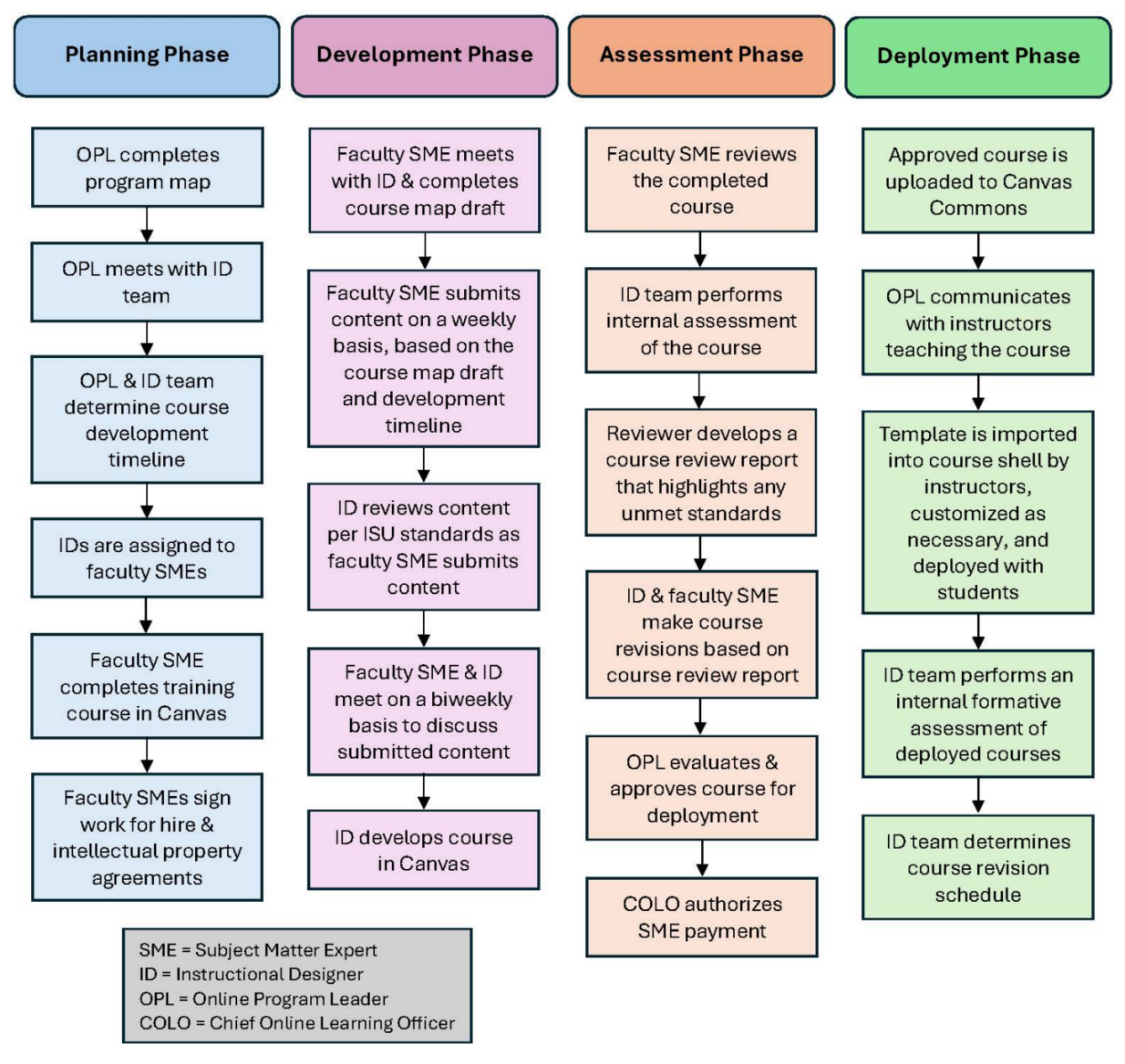
Figure 1: Online Template Course Development Process
Whenever possible, materials were shared between the SME training course and the APL training course, to ensure consistency in messaging regarding the process and the respective responsibilities of any stakeholders. This is especially important because, as the initial point of contact and the party who “hires” the Online and Extended Learning Unit to develop these courses alongside the selected SMEs, the APL is responsible for setting the tone for this entire relationship. They are the bridge between the SMEs and the IDs. With this in mind, Figure 1 is not only used in the APL training course, but also the SME training course. The SME training course at our institution was primarily developed by a former member of the team, Alyssa Herman.
Module 2: Your Role in the Planning Phase
In the second module, APLs are guided through the process of creating a program map, which includes program-level student learning outcomes, the designation of program courses that are aligned to each outcome, a timeline for each course development, special instructions for accreditation, compliance or other outside requirements, and involvement of other departments’ courses in the program. The training also provides guidance and recommendations to the APL to aid in the selection of effective SMEs.
Module 3: Your Role in the Development Phase
Although APLs are not involved in the day-to-day aspects of online course development, they receive periodic progress reports from the ID to keep them aware of how the process is advancing. In the rare occasion where APL intervention may be necessary (e.g., if the SME is not delivering content according to the agreed upon schedule, is not delivering content that meets the minimum standards, or no longer communicating with the ID), the module provides guidance and recommendations for how the APL might proceed (e.g. offering assistance, delaying the course development to another semester, identifying a replacement SME).
Module 4: Your Role in the Assessment Phase
One of the most important roles for the APL in the course development process is course evaluation (Martin & Kumar, 2018). The online template course development process includes a three-level course evaluation to ensure that quality standards and compliance requirements are met. The first level is an assessment completed by the SME. The second level is an internal OEL assessment conducted by an ID who is different than the ID assigned to the course. This level includes eight categories:
- Course Structure
- Course Information
- Course Support
- Objectives
- Learning Materials
- Interaction
- Assessment
- Accessibility
After the first and second level assessments are complete and any required modifications have been made, the final assessment is done by the APL, who is provided with teacher/faculty permissions within the online template course. The APL is provided with guidance for completing the Online Template Course Leadership Approval Form, which has four sections:
- Consistency with academic unit (the course goals, objectives, and content are consistent with those established by the academic unit and —if applicable—with corresponding face-to-face courses).
- Consistency with accreditation and other requirements.
- Flagged standards (any items from the internal review or the OPL review that may need attention).
- OPL approval (1-approved to be implemented, 2-approved when flagged standards have been met, or 3-requires modification and an addition review by APL).
Module 5: Your Role in the Deployment Phase
Once the course development has been completed and the course has been approved by the APL, it is ready to be deployed. The online template course master is designed to be “pristine,” i.e., instructors and students are not enrolled in the course master. This is to facilitate future updates and redevelopment of the course master without having faculty or student data in the master. A copy of the course master is placed in Canvas Commons to allow individual instructors to access and import the content into their courses.
In the last module, the APL is provided with guidance for communicating the nature of the online template courses to their faculty, the editing privileges given to faculty in these template courses, and the expectations for what faculty members will need to update in their courses before teaching the course (included in the Instructor Course Update Checklist available in each course in Canvas). Finally, guidance is provided to APLs to assist in determining when online template courses need to be considered for redevelopment and contact information for any questions or concerns.
Conclusion
The partnership model for course development (Xu & Morris, 2007) implies a two-way partnership, between the SME and the ID. In our team’s experience developing online template courses for fully online academic programs, it became clear that, while we are using the partnership model, this implication of a two-way partnership was doing a disservice to our academic program leaders, who are an essential part of this process. The online program development training for academic leaders provides valuable orientation and training for department chairs, associate deans, and deans. It clarifies APL roles, provides needed guidance and continues to be a go-to resource for those who oversee fully online degree and certificate programs. Perhaps more importantly, the existence of this training acknowledges the key role of the APL in course development. They deserve training too; let’s give it to them.
References
Aspillaga, M. (2016). Standardized templates help improve accessibility and usability enhancing transfer of knowledge. https://www.qualitymatters.org/sites/default/files/presentations/standardized_templates_help_improve_accessibility_aspillaga.pdf
Borgemenke, A. J., Holt, W. C., & Fish W. W. (2013) Universal course shell template design and implementation to enhance student outcomes in online coursework. Quarterly Review of Distance Education 14(1), 17-23.
Dowd, C. (2026). What week two of ahead rulemaking on accountability measures means for digital learning. WCET Frontiers. https://wcet.wiche.edu/frontiers/2026/01/21/what-week-two-of-ahead-rulemaking-on-accountability-measures-means-for-digital-learning/.
Downs, L. (2022). Regular and substantive interaction update: Where do we go from here? WCET Frontiers. https://wcet.wiche.edu/frontiers/2022/11/08/regular-substantive-interaction-update-where-do-we-go/.
Garrett, R., Legon, R., Fredericksen, E. E., & Simunich, B. (2020). CHLOE 5: The pivot to remote teaching in spring 2020 and its impact, the changing landscape of online education, 2020. Quality Matters. https://www.qualitymatters.org/sites/default/files/research-docs-pdfs/QM-Eduventures-CHLOE-5-Report.pdf
Hawkes, M., & Coldeway, D. O. (2002). An analysis of team vs. faculty-based online course development. Quarterly Review of Distance Education 3(4), 431-442.
Hill, P. (2012). The master course: A key difference in educational delivery methods. https://eliterate.us/the-master-course-a-key-difference-in-educational-delivery-methods/
Hixon, (2008). Team-based online course development: A case study of collaboration models. Online Journal of Distance Learning Administration 11(4). https://www.westga.edu/~distance/ojdla/winter114/hixon114.html
Hodges, C. B., Moore, S., Lockee, B. B., Trust, T., & Bond, M. A. (2020, March 27). The difference between emergency remote teaching and online learning. EDUCAUSE Review. https://er.educause.edu/articles/2020/3/the-difference-between-emergency-remote-teaching-and-online-learning.
Martin, F., & Kumar, S. (2018) Frameworks for assessing and evaluating e-learning courses and programs. In A. A. Piña, V.L. Lowell & B. R. Harris (Eds.) Leading and managing e-learning: What the e-learning leader needs to know (271-280). Springer.
McHaney, R. W., & Spire, L. (2014). Fewer snags for the department chair. Distance Education Report 18(17) 5-6
Piña, A. A. (2021). Managing the course development process. In L. D. Cifuentes (Ed.) A Guide to Administering Distance Learning (141-173). Brill Publishing.
Piña, A. A. (2023). Managing and evaluating online programs. In S. Wa-Mbaleka, L. Casimiro & K. Thompson (Eds.) The Sage Handbook for Online Higher Education (504-513). Sage Publishing.
Piña, A. A. & Martindale, T. (2023). Regular and substantive interaction in online courses: Why it matters for administrators. Online Journal of Distance Learning Administration 26(2). https://ojdla.com/articles/regular-and-substantive-interaction-in-online-courses-why-it-matters-for-administrators
Slaughter, D. S., & Murtaugh, M. C. (2018). Collaborative management of the e-learning design and development process. In A. A. Piña, V.L. Lowell & B. R. Harris (Eds.) Leading and managing e-learning: What the e-learning leader needs to know (253-270). Springer.
Xu, H, & Morris, L. V. (2007). Collaborative course development for online courses. Innovative Higher Education 32(1), 35-47.
Evan S. Brown is Senior Instructional Designer at Illinois State University, Normal, Illinois, 61790. Email: esbrown2@ilstu.edu.
Nichol Brown is Instructional Design Coordinator at Richland Community College, Decatur, Illinois. Email: nbrown@richland.edu.
Courtney Cox is an Instructional Designer at Illinois State University, Normal, Illinois, 61790. Email cecox12@ilstu.edu.
Anthony A. Piña is Chief Online Learning Officer at Illinois State University, Normal, Illinois, 61790. Email: aapina@ilstu.edu.
Stephanie L. Wilson is Senior Instructional Designer at Illinois State University, Normal, Illinois, 61790. Email: slwilso3@ilstu.edu.