

Abstract
This article introduces the Engaging with Content Holistically Online (ECHO) instructional framework, designed to guide faculty and instructional designers in creating transformative, student-centered online courses in higher education. ECHO provides scaffolded templates, guiding questions, prompts for using AI as a thought partner, and practical strategies for course design and implementation grounded in the Community of Inquiry and Technological Pedagogical Content Knowledge (TPACK) models. This framework emphasizes structured pedagogy, reflective practice, and contextualized design, enabling institutions to build cohesive online programs that promote engagement, critical discourse, and transformative learning. Implications for online program administration and faculty development are discussed.
Introduction
Online instruction is not a new concept in higher education. The first fully online degree was launched in 1989 by the University of Phoenix (n.d.). In the late 1990s, many nonprofit universities began to follow suit with online courses and degree programs (Kentnor, 2015). Initially, traditional universities struggled with a lack of understanding of online pedagogy and faculty buy-in, as they were concerned about program quality (Marcus, 2004; Shelton & Saltsman, 2005). However, in 2011, 65% of universities indicated that online education was critical to their long-term strategic plans, indicating that universities have learned to harness the power of technology to provide greater access to high-quality education (Allen & Seaman, 2011). The National Center for Education Statistics identified that 53.2% of college students took at least one online course in 2023 (NCES, 2025). Universities are not changing the knowledge that is shared but rather “how” the knowledge is shared.
Identifying a gap in current research and practice, the Engaging with Content Holistically Online (ECHO) instructional framework provides structured options for instructional designers and faculty to intentionally scaffold course and program design. Traditionally, instructional design conversations stall when faculty are asked how they want their courses or programs designed. ECHO addresses this challenge by providing instructional designers and faculty with targeted resources, including scaffolded course-design templates, online instructional strategies, prompts to use AI as a thought partner, and reflective questions that guide the decision-making process. This framework empowers faculty to make informed choices while navigating them towards creating a Community of Inquiry and designing transformative learning experiences.
Instructional Design
To implement an effective online program, research indicates a need for content, technological, and pedagogical knowledge on how to teach in an online environment (Koehler & Mishra, 2009; Trakru & Jha, 2019). When designed appropriately, online courses can increase student engagement, attendance, and student access by allowing faculty to use course facilitation to effectively transfer knowledge (Boothe et al., 2020; Castro & Tumibay, 2021).
The Engaging with Content Holistically Online instructional framework (ECHO) incorporates multiple principles of effective online pedagogy, including the integration of learning theories, assessment, and motivation. ECHO uses the Community of Inquiry model as one of the foundations for programmatic design. The Garrison et al. (2000) Community of Inquiry model highlights three key elements of the educational experience: social presence, cognitive presence, and teaching presence. When these elements are woven effectively into the online environment, increased engagement, critical thinking, and deep learning occur.
ADDIE model, which evolved from military instructional systems research, includes analysis, design, development, implementation, and evaluation (Allen, 2006), and Dick and Carey’s (2022) systematic design, which includes nine more detailed steps covering similar phases; remain foundational structures for instructional design. However, many online design models still lack the practical scaffolding and built-in reflection prompts that the ECHO instructional framework provides, positioning ECHO as a bridge between theoretical design and day-to-day online course development.
The following four models make broad statements about effective components of course design:
- Alonso and their team’s (2005) E-Learning
- Roblyer’s (2014) online and blended learning design theory
- Instructional Design and Online Learning (IDOL) Guidelines (FHI360, 2020)
- Quality Learning and Teaching (QLT) (California State University, 2022)
- Quality Matters (QM) (2023) Publisher Rubric
These models emphasize providing a welcome message, measurable learning objectives, multiple ways to demonstrate mastery or competency, and multiple types of assessment. Despite the availability of online instructional design models/frameworks, they lack a structured approach through the use of predesigned scaffolded templates, guiding questions, and targeted resources for online course design that lead to creating a Community of Inquiry and transformative learning experiences.
Additionally, to design and instruct effectively online, a framework must include the Technological Pedagogical Content Knowledge (TPCK) framework (Mishra & Koehler, 2006). TPCK is visually represented by three interconnected and overlapping circles, similar to a Venn diagram, to illustrate the individuality and interrelationship of technological knowledge, pedagogical knowledge, and content knowledge. Thompson and Mishra (2007) later had participants suggest a new acronym, TPACK, to facilitate ease of pronunciation and avoid its association with educational jargon, instead representing the “essential building blocks” of the framework for successful technology integration (p. 38). This framework was developed to encompass teacher knowledge related to technology integration, also known as technological pedagogical content knowledge, which built upon Shulman’s (1986, 1987) construct of pedagogical content knowledge. Shulman and Shulman (2004) evolved the idea of pedagogical content knowledge to extend beyond the individual to “a more comprehensive conception of teacher learning and development within communities and contexts” (p. 259). Similarly, Mishra (2019) surrounded the TPACK framework’s three circles by an outer dotted circle representing contextual knowledge, an encompassing knowledge domain. Teaching successfully with technology requires continually creating, maintaining, and re-establishing a dynamic equilibrium among all components (Koehler & Mishra, 2009). TPACK emphasizes the importance of a structured approach to online course development, particularly for teachers new to online curriculum development and instruction.
Engagement in Online Courses
Online programs have a lower retention rate than traditional programs. The level of student engagement is an important factor that can help retain students and increase learning, thus improving completion rates (Glazier, 2016). Engagement can occur through purposeful course design and faculty instruction as students learn through interaction with peers, faculty, and content.
Moreover, coursework can play an important role in facilitating the sharing of knowledge. Students need to learn from one another through interactive communication that creates critical discourse and reflection (Garrison et al., 2000). This learning does not need to take place synchronously but through purposeful assignments that foster knowledge-sharing and collaboration. Research demonstrates that online peer feedback, where students post their work and provide feedback to one another, serves as an effective instructional strategy for enhancing students’ learning processes and outcomes (Yu & Lee, 2024). This type of interaction can occur in a variety of ways within the online course, such as discussion boards where students post their work and engage in feedback with peers, and assignments that require critical thinking through student-centered pedagogical approaches. When designed intentionally, these activities support the development of cognitive presence essential to deep learning in online environments (Garrison et al., 2000).
As a result, courses using the ECHO instructional framework utilize a student-centered pedagogy aiming to transform the role of the faculty. Faculty are active facilitators of knowledge transfer and application through carefully crafted assignments, discussion boards, module design, content, recorded media, and other instructional elements.
Creating a Community of Inquiry and Critical Discourse
The Community of Inquiry model consists of three elements—social presence, cognitive presence, and teaching presence— represented by a diagram of three overlapping circles, similar to the TPACK image (Mishra, 2019), surrounded by an outer dotted circle (Garrison et al., 2000). Like Mishra and Koehler’s (2006) TPACK framework, the circles illustrate the individuality and interrelationship of social, cognitive, and teaching presence. The outer dotted circle of Garrison et al.’s (2000) Community of Inquiry model also identifies the influence of external factors or context:
- Social presence occurs when the student can present themselves as a ‘real person’ through student-to-student and student-to-teacher interactions.
- Cognitive presence occurs through the construction of meaning through interactive communication that creates critical discourse and reflection.
- Teaching presence refers to the crafting, guiding, and directing of cognitive and social processes to achieve individual meaningful and educationally valuable learning outcomes.
Designing an online environment where these three interdependent elements are present is where purposeful deep learning occurs.
It is important to note that these elements do not need to occur in a live or synchronous contexts to be effective; however, faculty must facilitate discussions, negotiate the construction of meaning, and identify misunderstandings. Faculty need to understand how to use technology to leverage learning and apply knowledge, model critical discourse, and provide continuous constructive feedback rather than using a limited “share your thinking and compare to your peers approach” (Garrison et al., 2000; Garrison & Kanuka, 2004).
To effectively implement the ECHO instructional framework, faculty reflect using guided questions that focus on creating an online environment that incorporates rich critical thinking and community development. The chart below focuses on ideas presented in Van Schie’s (2020) Concept Map of Community of Inquiry that are integrated into the ECHO instructional framework’s resources. Van Schie’s (2020) concept map further highlights the complexity of effective online design and instruction, which requires a multifaceted framework approach evident in ECHO.
Table 1
Community of Inquiry Components and Online Implementation
| Community of Inquiry | Components | Online |
| Social Presence | Engagement with Others Emotional Expression
Group Cohesion
Open Communication
Brave Space vs Safe Space
|
|
| Cognitive Presence | Engagement with Content Triggering event Topic or area of interest (broad) Collaborative environment
Exploration (personal and social)
Integration- constructing meaning from new ideas (ever-evolving)
Resolution- real-world problems
|
|
| Teaching Presence | Engagement with Course/Program Outcomes Instructional Design
Facilitating Discourse
Direct Instruction
|
|
Adult Learning
Adult learning has changed with the implementation of technology-based learning platforms, allowing adults to be more self-directed learners. Technology has enabled adult learners to access a variety of resources, including collaborative tools, self-assessment, feedback, progress monitoring, and scaffolding technology. This access allows learners to search for and apply information effectively, highlighting the need for faculty to identify what they need from technology before they can utilize it effectively (Laurillard, 2012).
Knowles et al. (2011) identify the core principles of andragogy, or the foundation of adult learning: Learner’s need to know, learner’s self-concept, learner’s prior experience, learner’s readiness to learn, learner’s orientation to learning, and learner’s motivation to learn. “Andragogy works best in practice when it is adapted to fit the uniqueness of the learners and the learning situation” (Knowles et al., 2011, p. 3). The ECHO instructional framework uses the core principles of andragogy in instructional design and online instruction; however, caution is placed on the needs of adult learners choosing online programs to ensure instructional decisions are not based on a learner’s immediate interests without viewing needs through an instructional decision-making lens (Ayers, 2011). By integrating these andragogical principles into online course design, the ECHO instructional framework ensures that adult learners are supported through intentional scaffolding, reflection, and flexible instructional design choices that respect autonomy while maintaining academic rigor.
Transformative Learning
While the introduction of the internet, social media, and artificial intelligence has provided a window into enormous amounts of information, it is crucial that online courses do not contribute to the passive consumption of content. Mezirow (1997) notes that a defining characteristic of humans is the need to understand the meaning of experiences. The transformative learning theory emphasizes the importance of critical reflection, dialogue, and experiences in enabling adults to change their perspectives, assumptions, and understandings.
The dictionary defines learning as the “knowledge or skill acquired by instructor or study” (Merriam-Webster, 2025b, para. 2). While knowledge is defined as “the fact or condition of knowing something with familiarity gained through experience or association” (Merriam-Webster, 2025a, para. 1), does learning occur without critical reflection, participation in dialogue, and experienced knowledge or skill? Transformative learning goes beyond acquiring information or mastering skills; it involves critically reflecting on our own and others’ assumptions, habits of mind, and frames of reference. Learning is much more than the accumulation of knowledge; fundamentally, learning is the ability and dispositions to question and examine values, beliefs, and judgments (Mezirow, 1997). Faculty must aim to help students develop autonomy, the ability to think independently, reflect critically on beliefs, and engage with others through critical discourse.
The Engaging with Content Holistically Online (ECHO) Instructional Framework
The ECHO instructional framework evolved out of necessity to effectively and efficiently transfer online design and instructional pedagogy to faculty with little to no prior online experience, beyond emergency remote teaching that occurred during the COVID-19 pandemic. The goal was to create a step-by-step course design approach through the development of explicit templates and guiding questions that scaffold the design of individual courses, focusing on meaningful engagement with content and peers, moving students to active co-constructors of knowledge, fostering a strong Community of Inquiry, and developing transformative learning experiences while receiving limited support from instructional designers due to finite human resources.
This purposeful design of individual courses leads to cohesive degree programs with all faculty working within the same framework. The templates’ scaffolded designs enable ease of Learning Management System builds for multiple courses within a single degree, designed by different faculty, with a consistent look, feel, and interaction for students.
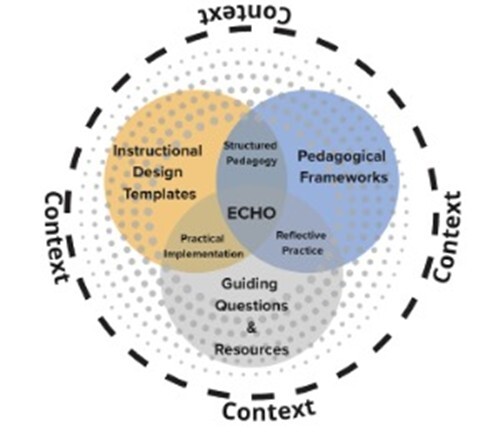
As detailed in Figure 1, the ECHO instructional framework, similar to TPACK and the Community of Inquiry, is represented by a diagram of three overlapping circles, similar to a Venn diagram, surrounded by an outer dotted circle; however, the ECHO instructional framework includes a series of dotted circles starting in the center and moving towards the outer dotted circle, representing the “echoing” effect. Each circle contains essential instructional design tools: pedagogical frameworks, guiding questions and resources, and instructional design templates. The intersection of pedagogical frameworks and instructional design is identified as structured pedagogy. This is where theory meets practical application, the blueprint (template) that shows how pedagogical principles are systematically implemented. Pedagogical frameworks overlap with guiding questions and resources leading to reflective practice, the “why” behind instructional choices. Practical implementation, the “what” and “how-to” of building courses, occurs when instructional design templates, guiding questions, and resources intersect. The outer circle constitutes context. In online courses, understanding the context of multiple learners—their needs, backgrounds, access to technology, and learning environments—is essential to ensure the ECHO instructional framework is implemented equitably across diverse populations. Finally, at the center of the diagram, where instructional design templates, pedagogical frameworks, guiding questions, and resources converge, a lasting impact is created that reverberates beyond the lesson into where transformative learning occurs.
The echo metaphor is appropriate for this framework. An echo requires the right environment (context). An echo involves repetition and reflection, modeling the iterative process of strong instructional design. Multiple echoes create harmony or discordance, highlighting the importance of aligning instructional design templates, pedagogical frameworks, guiding questions, and resources within the context of the population being served.
Figure 1
The Engaging with Content Holistically Online (ECHO) Instructional Framework
ECHO is presented as a proposed instructional framework currently in the early stages of formal implementation. Its design is informed by 18 years of applied experience in online instructional design and has been piloted in the development of multiple online courses. Research to evaluate ECHO’s effectiveness is currently underway, and empirical findings will be reported in future scholarship. The lack of empirical details within the article is intentional. At this stage in ECHO’s infancy, the value lies in its theoretically grounded, structured approach to a well-documented gap in faculty support.
To significantly impact online program administration, intentional scaffolding of the step-by-step process—outlining a course through designing individual module content, assignments, and assessment— through the use of predesigned templates and guiding questions supports faculty course development in meaningful and measurable ways. The ECHO instructional framework provides instructional designers with a structured, sequential pathway to onboard faculty to online instructional design. The ECHO instructional framework transforms what can be an overwhelming and isolating process into a manageable, iterative, and reflective practice, empowering faculty to design with independence and intention. Instructional designers are able to focus on deeper consultative work—engaging in meaningful pedagogical conversations with faculty, providing targeted feedback on course quality, and supporting the refinement of complex instructional decisions. Instructional designers direct their expertise where it matters most: strengthening the intellectual and pedagogical depth of the learning experience. This, in turn, supports creating high-quality online programs.
To implement the ECHO instructional framework, first, using the backwards design model (Wiggins & McTighe, 1998) and Universal Design for Learning (UDL) principles (CAST, 2025), faculty begin by completing a step-by-step course outline template. This template guides faculty systematically through the process of developing the course description and course outcomes, identifying key assessments and/or assignments, outlining module learning objectives and topics, selecting module readings and resources, and determining necessary instructional media. At this stage, faculty focus on the overall structure and alignment of the course rather than drafting specific module content. The guiding questions prompt faculty to engage with artificial intelligence (AI) as a thought partner to carefully consider how key assessments and assignments align with module outcomes and identified resources, ensuring that these elements effectively support and measure the intended course outcomes. The course outline template and guided questions serve as a step-by-step framework that enables faculty to design their course(s) with minimal assistance from instructional designers. The ECHO instructional framework provides a quality assurance measure and provides opportunities for the design team to dig deeper into other aspects of program or course design.
The following sample AI prompts, developed in collaboration with Anthropic’s (2025) Claude AI, illustrate how ECHO supports faculty in developing the course outline:
- Outcomes Brainstorming Session– I want to write course outcomes that go beyond 'students will understand X' to capture genuine transformation. For a course on [topic], help me brainstorm: What should students be able to DO differently after this course? How should their thinking change? What problems should they be equipped to tackle?
- Community of Inquiry Mapper– For this discussion activity [describe activity], help me identify how it fosters: (a) Social Presence (e.g., student-student connection, identity, and trust); (b) Cognitive Presence (e.g., triggering events, exploration, integration, and resolution); and (c) Teaching Presence (e.g., design, facilitation, and direct instruction). If any element is weak, suggest specific modifications.
Second, faculty use the course outline template to develop individual module content. Each module has its own template, designed in the same cadence, which includes guiding questions and AI prompts to aid in content development.
- Module Overview Page: Faculty are advised to leave this section for last. To scaffold design processes, the following should be created first: content pages, discussion boards, and assignments. Once the content is created, the faculty list module objectives; write the module introductions; estimate the time required to complete all module activities; and create a module checklist of readings, discussion boards, and assignments.
- Hook Development Brainstorming AI Prompt Example: I'm starting Module 1 on [topic] for [audience]. Help me brainstorm 15–20 different opening hooks that would grab students' attention in the first 2–3 sentences. Think variety, but ensure the content is factual: Surprising statistics, provocative questions, real-world scenarios, counterintuitive facts, compelling stories, current events connections, or personal challenges. What would make students think 'I need to understand this'?
- Hook Development Brainstorming AI Prompt Example: I'm starting Module 1 on [topic] for [audience]. Help me brainstorm 15–20 different opening hooks that would grab students' attention in the first 2–3 sentences. Think variety, but ensure the content is factual: Surprising statistics, provocative questions, real-world scenarios, counterintuitive facts, compelling stories, current events connections, or personal challenges. What would make students think 'I need to understand this'?
Content Exploration Page(s): Using the module topics identified in the course outline template, individual pages are developed for each essential topic aligned with module outcomes, key assessments, and assignments. Each page includes the readings and multimedia resources curated from the course outline template to facilitate students’ knowledge acquisition. Segmenting content is grounded in cognitive science research on developing schema. To build schema, organize information into discrete, topic-specific segments to support students in activating prior knowledge and integrate new concepts more effectively (Anderson & Pearson, 1984; Sweller, 1988). Requiring students to actively navigate between pages fosters intentional engagement to help students construct meaningful schema essential for critical thinking and discourse.
Each Content Exploration page includes prompts for discussion, collaborative annotation, or reflective activities that encourage students to interact with the content, their peers, and faculty. This interaction fosters a supportive academic community that deepens understanding through dialogue. The content also allows students to question their assumptions, connect new information to prior experiences, and engage in activities that support adult learners in transformative learning.
- Prior Knowledge Activation Activities AI Prompt Example: For a Content Exploration page on [specific concept], students might already know or have experienced [describe what they might know]. Brainstorm 10–12 different ways to activate their prior knowledge at the start of the page: Questions to consider, scenarios to recall, quick self-assessments to reflect upon, predictions to make, and connections to notice. Make them concrete and doable in 2–3 minutes.
- Prior Knowledge Activation Activities AI Prompt Example: For a Content Exploration page on [specific concept], students might already know or have experienced [describe what they might know]. Brainstorm 10–12 different ways to activate their prior knowledge at the start of the page: Questions to consider, scenarios to recall, quick self-assessments to reflect upon, predictions to make, and connections to notice. Make them concrete and doable in 2–3 minutes.
- Discussion Board/Regular and Substantive Interaction: Students can become disengaged with weekly discussion board prompts that include boilerplate language, such as the following: Write a 300-word response and respond to two peers' posts. Faculty are encouraged to use design activities that push students to think critically and engage in critical discourse, spearheading the development of a Community of Inquiry. Third-party tools are encouraged to provide a variety of interactions (e.g., Google Workspace, Perusall VoiceThread)
- Beyond Post-and-Respond Formats AI Prompt Example: I want to design discussions that break the 'post 300 words, respond to two peers' mold for [topic]. Help me brainstorm innovative formats: How could students debate? Engage in Socratic dialogue? Teach each other? Solve problems collaboratively? Analyze cases together? Role-play perspectives? Generate 12–15 specific discussion structures that promote authentic discourse.
- Beyond Post-and-Respond Formats AI Prompt Example: I want to design discussions that break the 'post 300 words, respond to two peers' mold for [topic]. Help me brainstorm innovative formats: How could students debate? Engage in Socratic dialogue? Teach each other? Solve problems collaboratively? Analyze cases together? Role-play perspectives? Generate 12–15 specific discussion structures that promote authentic discourse.
- Assessments/Assignments: To design effective assessments and assignments in an online environment, it is necessary to leverage other senses to compensate for the lack of visual cues and formative assessment data readily available in a brick-and-mortar classroom. Aligning assessments and assignments to clearly written learning objectives is essential. Universal Design for Learning (UDL) principles, such as providing multiple means of engagement, representation, and expression, are encouraged during the design process (Boothe et al., 2020). Incorporating iterative feedback cycles allows students to receive constructive feedback at multiple stages and have opportunities to revise and improve their work.
- Feedback–Rich Process Design AI Prompt Example: For this assignment on [topic], I want multiple feedback opportunities before final submission. Brainstorm a process that includes: What could students submit early for feedback? How could peers help each other? Where could self-assessment fit? What check-ins would prevent students from getting off track? Design a timeline with multiple touchpoints.
When an institution adopts the ECHO instructional framework, faculty experience a measurable shift in instructional design consistency and pedagogical reflection. Departments are better positioned to ensure alignment between course outcomes, assessments, and student engagement through the scaffolded templates, guided questions, and embedded prompts.
Conclusion
Education, now more than ever, needs to focus on helping students learn how to think, rather than what to think—a transformative learning approach. As universities increasingly focus on long-term strategic planning that prioritizes online education, there is a need for an instructional framework that offers a step-by-step, structured approach, utilizing intentional online design and instructional strategies to foster a strong Community of Inquiry and promote the development of transformative learning experiences. The Engaging with Content Holistically Online (ECHO) instructional framework addresses this need while supporting faculty independence and flexibility in developing learning experiences tailored to their disciplinary context and student needs. This approach equips students with essential skills to navigate complex problems, think critically, and engage thoughtfully.
References
Allen, I. E., & Seaman, J. (2011). Going the distance: Online education in the United States. The Online Learning Consortium. https://eric.ed.gov/?id=ED529948
Alonso, F., Lopez, G., Manrique, D., & Vines, J. M. (2005). An instructional model for web-based e-learning education with a blended learning process approach. British Journal of Educational Technology, 36, 217–235. https://doi.org/10.1111/j.1467-8535.2005.00454.x
Anderson, R. C., & Pearson, P. D. (1984). A schema-theoretic view of basic processes in reading. In P. D. Pearson (Ed.), Handbook of reading research (pp. 255–291). Longman.
Anthropic. (2025). Claude (Claude Sonnet 4.5) [Large language model]. https://claude.ai
Ayers, D. F. (2011). A critical realist orientation to learner needs. Adult Education Quarterly, 61(4), 341–357. https://doi.org/10.1177/0741713610392769
Boothe, D., Caspary, M., Simmons, R., & Heh, V. (2020). Enhancing learning in the online instructional environment through the use of Universal Design for Learning. Journal of Special Education Technology, 35(4), 179–193. https://doi.org/10.4148/2470-6353.1310
California State University. (2022.). Quality Learning and Teaching (QLT) rubric. https://ocs.calstate.edu/rubrics/qlt
CAST. (2025). The UDL guidelines. https://udlguidelines.cast.org/
Castro, M. D. B., & Tumibay, G. M. (2021). A literature review: Efficacy of online learning courses for higher education institution using meta-analysis. Education and Information Technologies, 26(2), 1367–1385. https://doi.org/10.1007/s10639-019-10027-z
Dick, W., Carey, L., & Carey, J. O. (2022). The systematic design of instruction (9th ed.). Pearson. FHI 360. (2020, August 28). Instructional design and online learning (IDOL) guidelines. Online Professional
English Network (OPEN), U.S. Department of State. https://eteacher-general.s3.amazonaws.com/COP%20Documents/Instructional%20Design%20and%20Online%20Learning%20Guidelines_OPEN_8.28.20.pdf
Garrison, D. R., & Kanuka, H. (2004). Blended learning: Uncovering its transformative potential in higher education. Internet and Higher Education, 7(2), 95–105. https://doi.org/10.1016/j.iheduc.2004.02.001
Garrison, R., Anderson, T., & Archer, W. (2000). Critical inquiry in a text-based environment: Computer conferencing in higher education. The Internet and Higher Education, 2(2–3), 87–105. https://doi.org/10.1016/S1096-7516(00)00016-6
Glazier, R. A. (2016). Building rapport to improve retention and success in online classes. Journal of Political Science Education, 12(4), 437–456. https://doi.org/10.1080/15512169.2016.1155994
Kentnor, H. (2015). Distance education and the evolution of online learning in the United States. Curriculum and Teaching Dialogue, 17(1–2), 21–34. https://digitalcommons.du.edu/cgi/viewcontent.cgi?article=1026&context=law_facpub
Knowles, M. S., Holton, E. F., & Swanson, R. A. (2011). The adult learner: The definitive classic in adult education and human resource development (7th ed.). Elsevier.
Koehler, M. J., & Mishra, P. (2009). What is technological pedagogical content knowledge? Contemporary Issues in Technology and Teacher Education, 9(1), 60–70. https://www.citejournal.org/volume-9/issue-1-09/general/what-is-technological-pedagogicalcontent-knowledge/
Laurillard, D. (2012). Teaching as a design science: Building pedagogical patterns for learning and technology. Routledge.
Marcus, S. (2004). Leadership in distance education: Is it a unique type of leadership? A literature review. Online Journal of Distance Learning Administration, 7(1). http://www.westga.edu/~distance/ojdla/spring71/marcus71.html
Merriam-Webster. (2025a). Knowledge. In Merriam-Webster.com dictionary. https://www.merriam-webster.com/dictionary/knowledge
Merriam-Webster. (2025b). Learning. In Merriam-Webster.com dictionary. https://www.merriam-webster.com/dictionary/learning
Mezirow, J. (1997). Transformative learning: Theory to practice. New Directions for Adult and Continuing Education, 1997(74), 5–12. https://doi.org/10.1002/ace.7401
Mishra, P. (2019). Considering contextual knowledge: The TPACK diagram gets an upgrade. Journal of Digital Learning in Teacher Education, 35(2), 76–78. https://doi.org/10.1080/21532974.2019.1588611
Mishra, P., & Koehler, M. J. (2006). Technological pedagogical content knowledge: A framework for teacher knowledge. Teachers College Record, 108(6), 1017–1054. https://doi.org/10.1111/j.1467-9620.2006.00684.x
National Center for Education Statistics. (2025). Trend generator [Data set]. https://nces.ed.gov/ipeds/trendgenerator/
Quality Matters. (2023). Standards from the Quality Matters Higher Education Rubric (7th ed.). https://www.qualitymatters.org/qa-resources/rubric-standards
Roblyer, M. D. (2014). Introduction to systematic instructional design for traditional, online, and blended environments. Pearson.
Shelton, K., & Saltsman, G. (2005). An administrator's guide to online education. Information Age Publishing.
Shulman, L. S. (1986). Those who understand: Knowledge growth in teaching. Educational Researcher, 15(2), 4–14. https://doi.org/10.3102/0013189X015002004
Shulman, L. S. (1987). Knowledge and teaching: Foundations of the new reform. Harvard Educational Review, 57(1), 1–23. https://doi.org/10.17763/haer.57.1.j463w79r56455411
Shulman, L. S., & Shulman, J. H. (2004). How and what teachers learn: A shifting perspective. Journal of Curriculum Studies, 36(2), 257–271. https://doi.org/10.1177/0022057409189001-2
Sweller, J. (1988). Cognitive load during problem solving: Effects on learning. Cognitive Science, 12(2), 257–285. https://doi.org/10.1207/s15516709cog1202_4
Thompson, A.D., & Mishra, P. (2007). Editors' Remarks. Journal of Computing in Teacher Education, 24, 38 - 64.
Trakru, M., & Jha, T. K. (2019). E-learning effectiveness in higher education. International Research Journal of Engineering and Technology, 6(5), 3594–3597. https://www.irjet.net/archives/V6/i5/IRJET-V6I520.pdf
University of Phoenix. (n.d.). The University of Phoenix history. Distance Learning HQ.
Van Schie, J. (2020). Concept map. The Community of Inquiry [Concept map].
Wiggins, G., & McTighe, J. (1998). Understanding by design. Association for Supervision and Curriculum Development.
Yu, S., & Lee, I. (2024). Online peer feedback in higher education: A synthesis of the literature. Education and Information Technologies, 29(1), 5793–5827. https://doi.org/10.1007/s10639-023-12273-8