


Abstract
As tenure-track faculty and online program coordinators, we have examined the online program infrastructure, as well as the individuals who work within it. This work presents a culmination of five years of inquiry that serves to challenge the current infrastructure of online programs and its support systems. Pulling from Freire’s foundational work in humanism, we recognize our responsibility to approach the field through the lens of empathy, reciprocal learning, and intentionality. Thus, we feel that it is our duty to contribute to an ethic of care for all entities working in the online environment. Based on our research, we present to the field nine best practices and a call to action in order to humanize the field and create change.
Keywords: online learning best practices, humanism, online faculty development, online program administrators
Supporting Online Programs and Faculty: A Push for Best Practices
In this scholarly paper, we summarize five years of our research related to supporting online programs and faculty. As tenure-track faculty who have worked in online programs and as online program coordinators, we have investigated the experiences of students, administrators, and faculty (both tenure-track and contingent) in similar roles. From this, we have gained multiple perspectives on the challenges of the online environment, which encompasses more than just the classroom. One of our greatest findings is that the research in this area has been focused primarily on the classroom, such as instructor presence and the technical and pedagogical side of online learning (Martin et al., 2020; Oyarzun & Martin, 2023); however, this leaves out other aspects such as institutional student support, mentoring for both faculty and students, administrative practices, and policy creation. Moreover, little work has been done to truly humanize the experiences of individuals within these online environments. This is where our work fills the dearth in the literature.
We started this work as solo faculty and program coordinators at an R1 institution in the Southeastern United States. I [Yvonne] have a PhD in Instructional Systems and 25 years of professional experience in instructional design, both in corporate and in higher education. I [Mary Ann] came into this space with a PhD in Adult and Higher Education and almost 11 years of experience as an administrator in student affairs and enrollment management. It is our combined expertise within our fields that provides the needed interdisciplinary understanding to examine the challenges within the structures of online learning from a humanistic lens. What drew us together was that we quickly found we needed mentorship and support. We were frustrated as new junior faculty having to learn how to navigate the online environment, institutional policy and procedures, and student support on our own. We questioned: Is it just us? Hence, our research began.
In the following sections, we will discuss what we found in the literature, as well as the research we conducted, resulting in four conference proceedings, one case study book chapter, three critical discourse analyses journal articles, and 10 conference presentations. In addition, we will discuss why we feel the urgency to present needed best practices for the field based on our research, as well as present what we see as future challenges and the need for a shift in perspective.
Literature Review
In online higher education, “defining online programmes can be complex due to the various definitions and terminology found in the literature” (Bodine Al-Sharif et al., 2024, p. 920). The vast majority of research related to online learning focuses on pedagogy, which encompasses student learning objectives, learning activities, and forms of assessment (Martin et al., 2020), as well as technological advancements, technological literacy, and the various learning management systems (Oyarzun & Martin, 2023). However, this dismisses the need for a holistic approach to online learning and the online learning environment. In this space, we challenge the relevance of the current approach to research as it overemphasizes the classroom and provides a narrow lens of examination that ignores larger structures within higher education, support systems, and the overall online human experience.
Students
Students are the major stakeholder in the online learning environment. Institutions of higher education and faculty must seek to create an inclusive online community that is intentionally designed to provide opportunities for engagement, academic support, and fostering non-academic communication (Dhami, 2020). Students need to feel recognized in every aspect - not just the course components (i.e., generic syllabus templates, LMS, text selection, assignments and assessments, etc.), but also through intentional dialogue (Earnshaw & Bodine Al-Sharif, 2023), structured co-curricular programming, and online academic and student services support. It is important to note that students most often receive this support from faculty, yet faculty within the online environment also need support to meet the needs of their students (Bodine Al-Sharif et al., 2024; Earnshaw & Bodine Al-Sharif, 2024, 2025). This can only be accomplished if the appropriate institutional structures are in place.
Faculty
There are a variety of faculty roles (i.e., tenured, tenure-track, contingent) teaching in the online environment (Colby, 2023; Kezar & Holcombe, 2015). Despite one’s role, all faculty in the online environment share similar struggles related to professional isolation (Kibaru, 2018; Perrotta & Bohan, 2020; Seaton & Schwier, 2014), workload demand and socio-emotional well-being (Earnshaw & Bodine Al-Sharif, 2023; Kellen & Kumar, 2021; Kibaru, 2018; O’Meara et al., 2022; Perrotta & Bohan, 2020; Seaton & Schwier, 2014), their ability to support students outside of traditional hours (Kibaru, 2018; Lin et al., 2012; Richter & Schuessler, 2019; Seaton & Schwier, 2014), and their own feelings of needing to be supported (McBeath & Hopkins, 2023). In addition, they lack the ability to receive a holistic performance review due to institutional dependence on student end-of-course evaluations (Goos & Salomons, 2017; Marzano & Allen, 2016; Miller & Digges-Elliott, 2021; Piña & Bohn, 2014, 2016), which fill the gap for national accreditation reporting (Higher Education Act of 1965, 2022; U. S. Department of Education, 2025).
The research related to support of online faculty and the online learning environment clearly suggests that there is not enough being done (Earnshaw & Bodine Al-Sharif, 2024). Institutions of higher education are not as proactive as they should be to meet the needs of online faculty (tenure-track and contingent) and the programs that they serve. Student retention in online programs is directly linked to the online infrastructure (Sorenson & Donovan, 2017; Travers, 2016). Specifically, online faculty may or may not interact with the support available to them depending on their knowledge of what is available (Jaschik & Lederman, 2019; Magda, 2019; Melonçon, 2017), time constraints (Butters & Gann, 2022), the modality in which the support is offered (Earnshaw & Bodine Al-Sharif, 2024), and its overall quality (Earnshaw & Bodine Al-Sharif, 2024). It is vital that institutions of higher education first assess faculty needs and then be intentional in communicating and providing access to requested resources.
Our Research
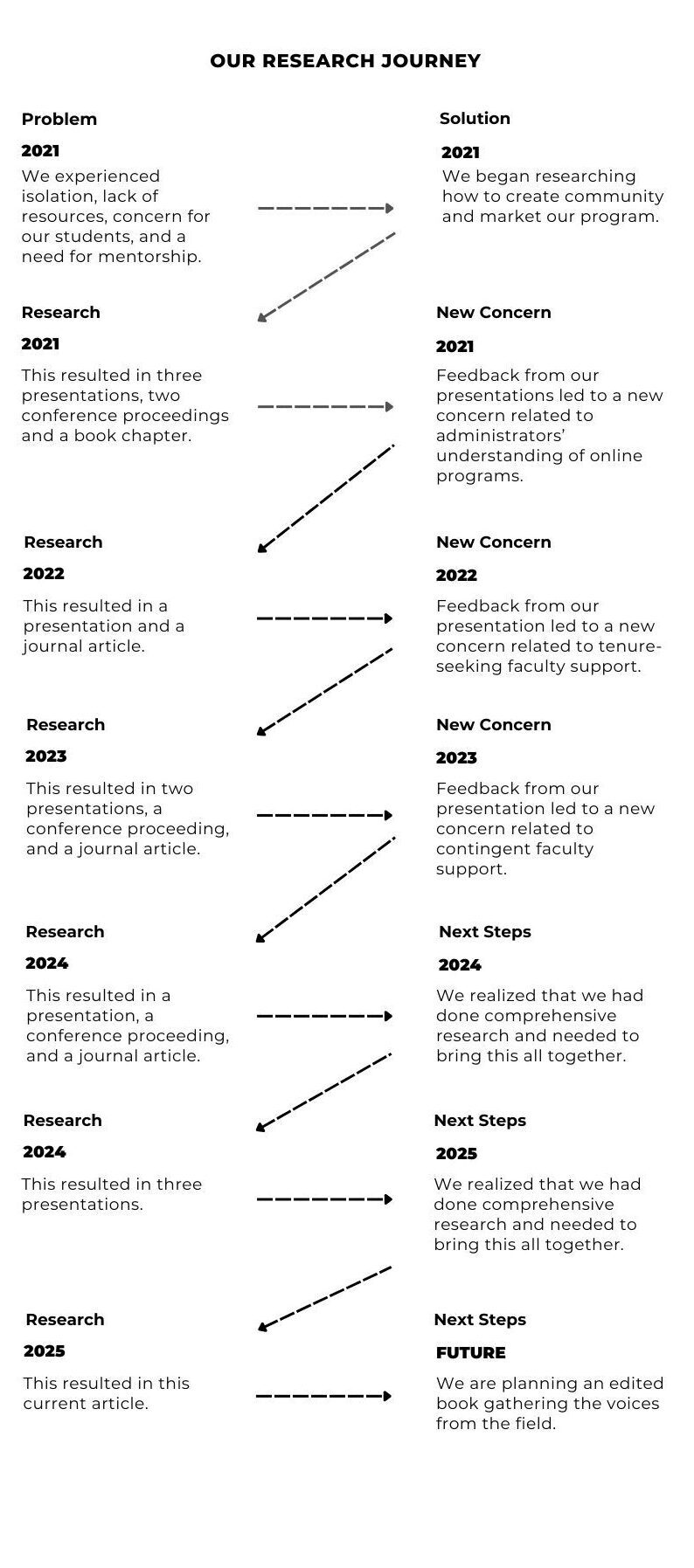
Our research over the last five years has focused on the online learning environment and those who participate within the space. We started this line of investigation due to our own challenges as individuals working as both online tenure-track faculty and program coordinators, as well as being responsible for the recruitment and hiring of contingent faculty. We began to question our knowledge of our roles and to ask important questions such as: Are we the only ones experiencing these roles like this? How do administrators perceive the work that we do? What are students’ experiences in the online learning environment? How are contingent faculty managing their responsibilities in these spaces? We did not have all the answers, but, as scholars, we had the skills to begin this line of research. Figure 1 shows an overview of where we started in this journey and how far we have come.
Figure 1
Our Research Journey Depicting the History of What Led Us to Each Study
Humanizing the Experience Through Best Practices
The key principles of humanism, according to Freire (2018), are that society has a responsibility for taking care of itself through empathy, reciprocal learning, and intentionality. We argue that these principles are highly conducive to the needs of individuals working and participating in an online learning environment. Institutions of higher education have a duty to take care of all entities (i.e., students, faculty, staff, administrators) who engage within the learning environment. Through empathy, higher education can improve academic outcomes, develop communication, and build trust. Likewise, higher education can create an environment for reciprocal learning, enabling both the instructor and learner to gain knowledge from one another. Perhaps most importantly, by being intentional in action, institutions of higher education can better align resource allocation with actual needs assessments, and thus, provide the right support where it is needed. For the online learning environment, this is of the utmost importance.
Our 5-years of research recognized that a missing component within the online learning environment is the humanizing of the overall online experience. This includes administrative oversight, support services, faculty mentoring, and effective communication. Therefore, based on the depth of our work, we have developed the following best practices and present them to the field with urgency:
- Recognize that every institution is serving at least two campuses—a virtual campus and a physical campus—and be intentional in the creation of an inclusive community; creating resources that can be used in both spaces (i.e., writing center, counseling center, student support service offices)
- Create a multi-layered approach to mentoring which recognizes that individuals will have a multitude of needs across the institution that must be addressed; a single individual mentor cannot provide all the knowledge needed
- Require ongoing assessment of faculty and student engagement beyond technical, pedagogical, teaching evaluations, and recruitment and enrollment processes
- Deliberately include online contingent faculty in all communications from the institution, department, and program
- Offer professional development for online contingent faculty
- Create an online contingent faculty handbook
- Formally evaluate online contingent and tenure-track/tenured faculty beyond end-of-course evaluations because current practice related to student evaluations is shown to be ineffective in evaluating the performance of faculty who teach in any modality
- Evaluate doctoral prep programs to ensure that they are appropriately discussing pathways to the professoriate which may include teaching in online modalities and set realistic understandings about work in contingent roles
- Develop onboarding for all administrators over online programming and all online faculty (contingent and tenure-track/tenured)
A Call to Action
As we close out this work, we implore our reading audience to consider their next steps in this process. There is still work to be done. Our research is just the beginning of this expanded journey. The future of online learning and the online learning environment is dependent upon the intentionality of institutions of higher education in humanizing the experience. Individuals working within these spaces need to be seen, heard, and respected. This requires recognizing that their needs go past the bells and whistles of technology and pedagogical practice to include professional development and acknowledgement within the institution. For example, contingent faculty make up a large percentage of the higher education workforce (Colby, 2023) and are teaching in online programs with little to no support. We must reframe our thinking about the online learning environment and change our practice. Higher education and administrators must do better. With intentional planning, resource allocation, and assessment, online learning will flourish. Without it, we lose our domestic and global workforce advantage.
References
Bodine Al-Sharif, M. A., Earnshaw, Y., & Corcoran, S. (2024). The “woeful” state of
administrative support for online programmes: A critical discourse analysis. Higher
Education Quarterly, 78(3), 918–933. https://doi.org/10.1111/hequ.12497
Butters, D., & Gann, C. (2022). Towards professionalism in higher education: An exploratory
case study of struggles and needs of online adjunct professors. Online Learning,
26(3), 259–273. https://doi.org/10.24059/olj.v26i3.2801
Colby, G. (2023, March). Data snapshot: Tenure and contingency in US higher education.
https://www.aaup.org/sites/default/files/AAUP Data Snapshot.pdf
Dhami, H. (2020, May 12). 5 tips for creating a true online learning community. Top Hat.
https://tophat.com/blog/online-learning-community/
Earnshaw, Y., & Bodine Al-Sharif, M. A. (2023). Developing an inclusive community in online
programs. In B. Hokanson, M. Exter, M. Schmidt, & A. Tawfik (Eds.), Toward inclusive
learning design: Social justice, equity, and community (pp. 481–492). Springer.
https://doi.org/10.1007/978-3-031-37697-9_37
Earnshaw, Y., & Bodine Al-Sharif, M. A. (2024). Supporting tenure-seeking faculty in online
programs: A critical discourse analysis. Online Learning, 28(4), 258–278.
https://doi.org/10.24059/olj.v28i4.4136
Earnshaw, Y., & Bodine Al-Sharif, M. A. (2025). It’s a situationship: How online contingent
faculty talk about their needed support. Online Learning, 29(2), 95–117.
https://doi.org/10.24059/olj.v29i2.4507
Freire, P. (2018). The pedagogy of the oppressed. Bloomsbury Academic.
Goos, M., & Salomons, A. (2017). Measuring teaching quality in higher education: Assessing
selection bias in course evaluations. Research in Higher Education, 58, 341–364.
https://doi.org/10.1007/s11162-016-9429-8
Higher Education Act of 1965, P. L. 89–329. (2022).
https://www.govinfo.gov/content/pkg/COMPS-765/pdf/COMPS-765.pdf
Jaschik, S., & Lederman, D. (2019). 2019 Survey of faculty attitudes on technology. Inside
Higher Ed. https://www.insidehighered.com/sites/default/files/media/IHE_2019_
Faculty_Tech_Survey_20191030.pdf
Kellen, K., & Kumar, S. (2021). Types of barriers experienced by online instructors in higher
education. Online Journal of Distance Learning Administration, 24(4).
https://ojdla.com/articles/types-of-barriers-experienced-by-online-instructors-in-higher-
education
Kezar, A., & Holcombe, E. (2015). The professoriate reconsidered: What might the faculty look
like in 2050? Academe, 101(6).
https://www.aaup.org/article/professoriate-reconsidered#.W0PHp9hKii4
Kibaru, F. (2018). Supporting faculty to face challenges in design and delivery of quality courses
in virtual learning environments. Turkish Online Journal of Distance Education, 19(4),
176–197. https://doi.org/10.17718/tojde.471915
Lin, H., Dyer, K., & Guo, Y. (2012). Exploring online teaching: A three-year composite journal
of concerns and strategies from online instructors. Online Journal of Distance Learning
Administration, 13(3).
https://www.westga.edu/~distance/ojdla/fall153/lin_dyer_guo153.html
Magda, A. J. (2019). Online learning at public universities: Recruiting, orienting, and
supporting online faculty. The Learning House, Inc.
Martin, F., Sun, T., & Westine, C. D. (2020). A systematic review of research on online teaching
and learning from 2009 to 2018. Computers & Education, 159.
https://doi.org/10.1016/j.compedu.2020.104009
Marzano, M. P., & Allen, R. (2016). Online vs. face-to-face course evaluations: Considerations
for administrators and faculty. Online Journal of Distance Learning Administration,
19(4). https://ojdla.com/archive/winter194/marzano_allen194.pdf
McBeath, B., & Hopkins, K. (2023). Needs assessment on the changing role of the university
professor. Human Service Organizations: Management, Leadership & Governance,
47(3), 149–156. https://doi.org/10.1080/23303131.2023.2232644
Melonçon, L. (2017). Contingent faculty, online writing instruction, and professional
development in technical and professional communication. Technical Communication
Quarterly, 26(3), 256–272. https://doi.org/10.1080/10572252.2017.1339489
Miller, C. T., & Digges-Elliott, H. (2021). Status of online learning. In L. Cifuentes (Ed.), A
guide to administering distance learning (pp. 1–19). Brill.
O’Meara, K., Culpepper, D., Misra, J., & Jaeger, A. (2022). Equity-minded faculty workloads:
What we can and should do now. ACE, American Council on Education.
https://www.acenet.edu/Documents/Equity-Minded-Faculty-Workloads.pdf
Oyarzun, B., & Martin, F. (2023). A systematic review of research on online learner
collaboration from 2012-2021. Online Learning, 27(1), 71–106.
https://doi.org/10.24059/olj.v27i1.3407
Perrotta, K. A., & Bohan, C. H. (2020). A reflective study of online faculty teaching experiences
in higher education. Journal of Effective Teaching in Higher Education, 3(1), 50–66.
https://janeway.uncpress.org/jethe/article/id/1553/
Piña, A. A., & Bohn, L. (2014). Assessing online faculty: More than student surveys and design
rubrics. Quarterly Review of Distance Education, 15(3), 25–34.
Piña, A. A., & Bohn, L. (2016). Assessing online faculty. In A. A. Piña & J. B. Huett (Eds.),
Beyond the online course: Leadership perspectives on e-learning (pp. 317–330).
Information Age Publishing.
Richter, S. L., & Schuessler, J. B. (2019). Nursing faculty experiences and perceptions of online
teaching: A descriptive summary. Teaching and Learning in Nursing, 14(1), 26–29.
https://doi.org/10.1016/j.teln.2018.09.004
Seaton, J. X., & Schwier, R. (2014). An exploratory case study of online instructors: Factors
associated with instructor engagement. International Journal of E-Learning & Distance
Education, 29(1), 1–16. http://ijede.ca/index.php/jde/article/view/870/1536
Sorenson, C., & Donovan, J. (2017). An examination of factors that impact the retention of
online students at a for-profit university. Online Learning, 21(3), 206–221.
https://doi.org/10.24059/olj.v21i3.935
Travers, S. (2016). Supporting online student retention in community colleges. What data is most
relevant? Quarterly Review of Distance Education, 17(4), 49–61.
U. S. Department of Education. (2025). Overview of the Accreditation in the United States.
Retrieved on October 3, 2025. https://www.ed.gov/laws-and-policy/higher-education-
laws-and-policy/college-accreditation/overview-of-accreditation-united-states