

Abstract
Regular and substantive interaction (RSI) is important in education, particularly in online learning (whether hybrid, synchronous, or asynchronous). Piña & Martindale (2023) make a compelling argument on why college and university administrators must be concerned about regular and substantive interaction, as it impacts financial aid and accreditation. While administrators should and must be concerned about RSI in online learning because of regulatory, financial, and compliance issues, it is ultimately up to faculty to uphold high academic standards and ensure that regular and substantive interaction is taking place in all of their classes, whether F2F, hybrid, synchronous, or asynchronous. Faculty should have access to training on best practices (Chickering & Gamson, 1986) for online teaching in order to maintain regular and substantive interaction (RSI) and ensure that not only their institutions meet compliance issues but that students are receiving worthwhile and academically rigorous instruction that encourages student engagement and active participation. As such, it is within faculty purview to effect change and implement content area expertise in all courses, including asynchronous, hybrid, and asynchronous courses.
Introduction
According to the National Center for Education Statistics (“Fast facts: Distance learning,” 2023), 61% of all undergraduate students were enrolled in at least one online course during Fall 2021. Although much of the surge in enrollment in online course offerings was a result of the COVID-19 pandemic, the RP Group has found that more than half of college students in the United States are enrolled in at least online course (2025). Researchers have estimated that half of all faculty switching from on-campus to online and remote teaching as a result of the COVID-19 crisis had no prior experience in online course design or instruction and that the resulting courses were less than ideal (Chan, Bista, & Ryan, 2022; Nworie & Charles, 2021). It would not be a stretch of the imagination to assume that many online courses developed under duress during the pandemic and that continue to be offered post-pandemic would, in an audit, could be classified as correspondence courses. Distance education began as correspondence courses to where it is now online. Moore (2019) explains his theory of transactional distance from its origins in correspondence courses, which he proposed would benefit from instructor-learner interactions back in 1972. In effect, the theory points to how students and instructors behave and interact outside of a traditional classroom setting (Moore, 2019).
Online courses—whether asynchronous or synchronous—are subject to accreditation standards. One criterion enforced by accrediting agencies is regular and substantive interaction (RSI), aligns with the federal, state, and local regulations. The Academic Senate for California Community Colleges (ASCCC) states that “colleges and districts must have both a clear definition of regular and substantive interaction (RSI) that aligns with the federal, state, and ACCJC definitions as well as a rubric in place to assess how and where that contact is designed to take place in a course taught online;” additionally, the ASCCC maintains that “the matter of regular and substantive interaction is clearly an academic and professional matter that should be led by faculty expertise” (2024). This is because faculty have purview over their involvement in accreditation processes, among other faculty roles such as content area expertise. Similarly, the Department of Education (2020) outlines how institutions should “provid[e] the opportunity for substantive interactions with the student on a predictable and regular basis or monitoring the student’s academic engagement and success and ensuring that an instructor is responsible for promptly and proactively engaging with the student— as opposed to requiring the institution to take both of those actions (54759),” thus giving instructors the lead for providing RSI.
Providing Regular and Substantive Interaction
While the primary focus is on online teaching and learning, all forms of teaching (F2F, hybrid, synchronous, or asynchronous) require best practices, and it is imperative that instructors follow these best practices. A standard framework promoting best practices in teaching and learning is Chickering and Gamson’s Seven Principles for Good Practice (1986), based on 50 years of research done in higher education. This framework illustrates practices for engaging students with their instructors, classmates, and with course content. The theoretical assumption for this framework is that student engagement is vital to good practices in the learning environment. The Seven Principles are:
1. Good practice encourages student-faculty contact, 2. Good practice encourages cooperation among students, 3. Good practice encourages active learning, 4. Good practice gives prompt feedback, 5. Good practice emphasizes time on task, 6. Good practice communicates high expectations, and 7. Good practice respects diverse talents and ways of learning. (Chickering & Gamson, 1986, pp. 1-2)
According to Kuh (2001), the Seven Principles are the “best known set of engagement indicators” (p. 1). These principles have been applied to the use of technology in teaching by Chickering and Ehrmann (1996). In addition, the Seven Principles framework has been found to help reduce student attrition in online learning, particularly Principle 3, active learning (Tirrell & Quick, 2012). A literature review of the 7 Principles and online instruction (Griffith, Statti, & Torres, 2022) found that Chickering and Gamson’s 7 Principles could help faculty teaching online increase student engagement and help administrators with student retention. As an example, Cho & Cho (2016) contend that scaffolding strategies in the form of posting announcements, participating in discussion boards, encouraging student questions, and monitoring academic progress promote student-instructor interactions, while student-student interactions are fostered by setting standards for posting, facilitating discussion board interactions, and posing relevant questions. Furthermore, the National Survey of Student Engagement (NSSE) and the CCCSE (Center for College Student Engagement) developed their benchmarks based on the Seven Principles (Kuh, 2001). Chickering and Gamson’s (1986) Seven Principles serve as the foundation for the NSSE benchmarks, which are five clusters of effective educational practice: academic challenge, active and collaborative learning, student–faculty interaction, enriching educational experiences, and supportive campus environment (Kuh, 2001). The Seven Principles, combined with student engagement, serve to build a strong foundation for regular and substantive interaction in the online learning environment.
Student engagement in the online learning environment might seem like an oxymoron; however, many students in the online learning environment have reported high student engagement (Robinson and Hullinger, 2008; Lerma, 2011). Student engagement is defined as educationally effective practices which take place both in and out of the classroom that lead to positive, measurable outcomes and is connected to the time and energy students apply to activities in their academic career (Barkley, 2010; Harper & Quaye, 2009; Jacobi, Astin, & Ayala, 1987; Kuh, 2001; Pascarella & Terenzini, 2005). It also relates to the practices and policies that institutions use in order to achieve these goals (Kuh, 2003). Through this perspective of student engagement, institutions of higher learning can focus on proving quality education (Astin, 1993) reflecting a range of educationally meaningful interactions for students in their respective institutions (Kuh, Kinzie, Schuh, Whitt, & Associates, 2005). Student engagement has two components: The first relates to the amount of time and effort that students put into studying a subject, practicing, receiving feedback, and analyzing and solving problems (Kuh, 2001). The second component in student engagement relates to the ways in which institutions foster student success by allocating resources and by providing services and opportunities for students (Kuh, Kinzie, Schuh, & Whitt, 2005). Student engagement information serves to measure students’ intrinsic involvement in their learning (Kuh, Kinzie, Schuh, & Whitt, 2005), while the assessment of student engagement in key educational process both indirectly (Ewell & Jones, 1993) and directly (Kuh et al., 1994) measures educational outcomes. Barkley (2010) maintains that student engagement occurs at a continuum, starting at the intersection of motivation and active learning. Engagement theory (Kearsley & Shneiderman, 1999) focuses more on the role of students in engagement and has three components, Relate, Create, and Donate. This theory is based on the premise that learning occurs in groups, is project-based, and has an authentic focus, which also increases student motivation and satisfaction as students feel they are contributing to a worthwhile cause. Conversely, Chickering and Gamson’s (1987) Seven Principles emphasize the instructor’s role in providing engagement strategies.
Activities Considered Regular and Substantive
Instructors can develop regular and substantive activities following the Seven Principles (Chickering & Gamson, 1986) and promoting the guidelines behind student engagement (Barkley, 2010; Harper & Quaye, 2009; Pascarella & Terenzini, 2005). Many institutions (The Ohio State University, SUNY Empire State, CSU Stanislaus, San Diego Community College District, and Orange Coast College, among others) provide guidelines for regular and substantive interaction (RSI) in the online teaching and learning environment.
At Orange Coast College (OCC), located in Costa Mesa, California and a top transfer community college, RSI is supported through institutionally developed guidance, faculty training, and peer review processes aligned with ACCJC and federal expectations. While RSI efforts are driven by a standardized rubric, faculty are supported in designing courses that demonstrate regular and substantive interaction through multiple forms of engagement, including announcements, feedback on student work, facilitation of discussions, and direct communication with students. RSI is expected to be clearly visible within student-facing areas of the course, ensuring both transparency for students and alignment with accreditation standards. Peer review and institutional support structures help faculty identify where and how RSI is present, with an emphasis on consistency, clarity, and meaningful academic engagement. Below is the rubric used by the ACCJC to measure RSI in asynchronous and synchronous classes:
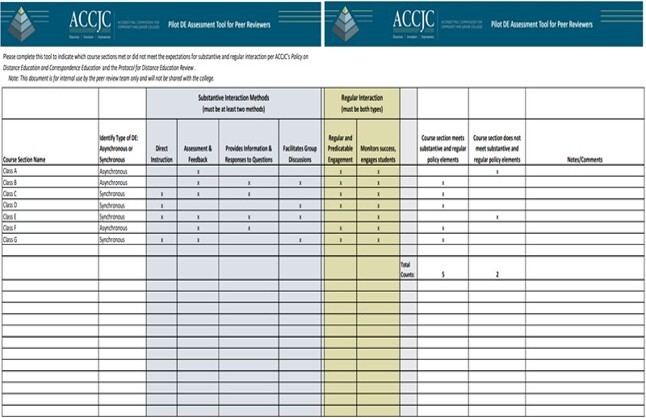
Community and junior colleges need to meet the required 85% RSI threshold in online asynchronous and synchronous courses (through a random sample of courses offered at a given college during the accreditation period) in order to maintain their accreditation standards. As can be seen from the chart above, the criteria are: direct instruction, assessment and feedback, provides information and responses and questions, facilitates group discussions (under the substantive interaction methods category), and under the regular interaction category, the standards are: regular and predictable engagement, monitors success, and engages students. The final determination is “Course section meets substantive and regular policy elements”—or “Course section does not meet substantive and regular policy elements.”
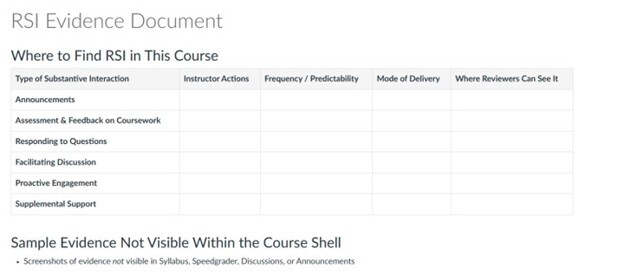
In an effort to meet that goal, the Online Coordinator and certified peer reviewers at our College worked with faculty teaching online to ensure that the accreditation team found evidence of RSI in our online asynchronous and synchronous course. At present, we are using Canvas as our course management system (CMS). A rubric was developed by the OCC Instructional Innovation Center (IIC) team, including the Online Coordinator. It was then delivered to our Canvas Account as “Shared Content,” which we could then import to our course(s). Canvas course links fitting each criterion were then inserted onto the rubric. Faculty were instructed to develop a 0 module (not visible to students) so that the accreditation team could readily find evidence of RSI. Below is our rubric:
Faculty teaching asynchronous and synchronous classes attended a college-wide meeting held via Zoom to learn more about the RSI process and then met with a certified peer reviewer to discuss the criteria for their course(s).
For example, for the first criterion, “Announcements,” faculty were told to post at least one announcement per week, so a 16 week class would ideally have 16 announcements. Announcements could serve to introduce the week’s assignments, provide reminders, clarify common student questions and concerns, and give an overall summary of that week's assignments. In some CMS, announcements also go to student email. This aligns with Chickering and Gamson’s Principles 1, (student-faculty contact), 3 (active learning), 4 (prompt feedback), and 5 (time on task). According to Martin and Bollinger (2018, cited in Griffith, Statti, & Torres, 2022), students appreciate regular announcements and reminder emails to keep them on track and engaged in the online learning environment.
Criterion 2, “Assessment & Feedback on Coursework,” requires meaningful feedback on students’ submitted work (not “Good job!”). Instructors need to provide comments related to each student’s specific submission, especially if assignments require multiple drafts and/or will be part of a cumulative assessment. This follows the four principles addressed above, with the addition of Principle 6: “Good practice communicates high expectations.” That is, coursework should be academically rigorous, challenging students to meet or exceed high expectations. In order to help students meet high expectations, instructors have to provide meaningful and useful feedback in the form of written comments, highlighting the positive parts of the assignments, while providing suggestions for revision and/or improvement.
“Responding to Questions” (Criterion 3) refers to instructors’ replying to student questions and concerns. This can be done through a question and answer discussion board, announcements, and the CMS email/regular faculty email. This meets Chickering and Gamson’s Principles 1 (student-faculty contact) and 4 (prompt feedback), which is crucial in order to help students get their assignments done in a timely manner. Instructors should post their response guidelines (“I will respond to your inquiry within 24 hours”) so that students know when to expect a response. Online students have stressed the importance of scheduled office hours and timelines for email responses and weekly faculty interaction and presence (Watson et al., 2017).
Criterion 4 (Facilitating Discussion) and Criteria 5 (Proactive Engagement) can be accomplished in many ways—audio, video, and interactive tools such as Google Docs, Google Slides, and Slido.com. Discussion boards are one of many ways to facilitate interaction in an online course, alongside instructor feedback, announcements, and direct communication with students. Discussion boards can facilitate discussion and lead to proactive student engagement. As instructors, we can use discussion boards in a variety of ways. Research (Mohebi, 2023; Kumi, 2023; Williams & Lahman, 2023) points to the usefulness of using discussion boards in the online teaching environment, which lead to reflective answers, critical thinking, active learning, and open dialogue, with an opportunity to respond to feedback.
As an instructor of two first-year college writing classes (one hybrid and the other asynchronous), I use discussion boards for different assignments (introductions, reading comprehension questions, reflections on readings and videos, thesis statements, and sentence completions, among others), to which students have to reply (sometimes based on their roster number). They then have to provide meaningful, constructive responses to four classmates; therefore, students have to provide five total posts for each discussion board prompt. A rubric outlines certain criteria: meaningful and relevant, at least three well-developed sentences with appropriate grammar, punctuation, and spelling. For the most part, students appear to feel free to express themselves without judgement. They seem to appreciate the time and space to be reflective of their learning processes and life experiences. While I do interact with students on the discussion board, I allow time for other students to post their replies before I reply. For example, when students are posting their thesis statements for a given paper, I wait for at least two students to comment before writing my suggestions. This is empirical evidence: Students have stated that they have had more engagement and interest in expressing their thoughts in the discussion board (both hybrid and asynchronous courses) than they have had in their F2F classes; again, this is my empirical evidence and experience. The discussion board in my professional development class to teach online is what convinced me that I could transform my F2F classes into hybrid and even asynchronous modalities.
Finally, Criterion 5 is “Supplemental Support.” Many instructors have links to services on campus (The Writing Center, Health Center Services, Office for Students with Disabilities, Free Bus Passes, Library Databases, Supplemental Support Classes, etc.) on their CMS Course Homepage and/or on their CMS syllabus. Instructors can also send some of this information via Announcements (which is usually then sent via email). This reflects Chickering and Gamson’s 7th Principle: “Good practice respects diverse talents and ways of learning.” This is also the second component in student engagement, which relates to the ways in which institutions foster student success by allocating resources and by providing services and opportunities for students (Kuh, Kinzie, Schuh, & Whitt, 2005).
Why This Matters To Faculty
Faculty are here to serve and help students succeed. We need institutions in which to teach; institutions need to be accredited in order to continue to function….and survive. Faculty need to be part of the solution. We should and can help our institutions not only survive but thrive. Regular and substantive interaction (RSI) is part of any teaching and learning environment: F2F, synchronous, asynchronous, and hybrid.
Recommendations
Institutions—colleges and universities—have to provide the necessary training to instructors on how to best teach an online class, following best practices. At the same time, faculty have to be open to professional development in this area. Many faculty have concerns about online pedagogy training being foisted upon them, among other faculty responsibilities. Institutions can offer professional development credit, stipends, or even salary advancement credit. The following are the recommendations from the RP Group (2025):
- Establish clear guidelines and definitions for online education;
- Improve data collection and reporting practices and procedures;
- Invest in faculty development and technology infrastructure; and
- Promote ongoing research and evaluation.
In addition to online courses being relatively “new,” pedagogy has shifted from instructors “being the sage on the stage to being a guide on the side” (King, 1993). As Pascarella and Terenzini (2005) have found in extensive studies, the emerging model in higher education is a shift from teacher centered to learner centered, where students learn from each other and instructors serve as facilitators and guides in the learning process. This relates to student-instructor interaction and student-student interaction, as well as student engagement in the learning process. Online professional development courses (for example, ACUE) are sometimes offered at no cost through an institution. Another program @One offers both free courses and graduate credit for salary advancement. The Online Learning Consortium (formerly the Sloan Consortium 5 Pillars) offers guidelines to online teaching: OLC . In sum, institutions, administrators, and instructors have to work together to make informed decisions that benefit both the institution and the instructor—and above all, our students.
Conclusion
Piña & Martindale (2023) contend that college and university administrators must be concerned about regular and substantive interaction (RSI), as it impacts financial aid and accreditation; institutions, however, also need to work toward developing professional development in pedagogical models in online learning and teaching environments, which are not dissimilar to tradition F2F models: having proactive faculty-student interaction, engaging student-student interaction, active learning among students and instructors, prompt and meaningful feedback from instructors on assignments and assessments, scaffolding assignments (time on task) to meet learning objectives related to prompt, timely, and meaningful feedback from the instructor and other students, rigorous and relevant material (readings, assignments, assessments, videos, PowerPoints, etc.) that create high expectations, while recognizing and honoring students’ diverse modes of learning (visual, auditory, etc.) and understanding special needs and accommodations, following Chickering & Gamson’s Seven Principles for Good Practice (1986). Discussion boards, instructor feedback, announcements, and direct communication with students are crucial to facilitating interaction in an online course. It is imperative that institutions, with faculty, administrator, staff, and student input, work to develop, implement, and enforce policies that will ensure a well-developed teaching and learning online environment. Instructors and students can learn from each other and achieve the course learning outcomes. Students can be academically successful through student engagement strategies, leading to their professional and personal growth. Above all, faculty have to be invested in developing RSI in their online classes to help students foremost.
References
Accrediting Commission for Community and Junior Colleges (ACCJC). (2024). https://www.laspositascollege.edu/gv/academicsenate/assets/docs/2025-2026/10.22.25/ACCJC-Quality-Continuum-Rubric-for-Distance-Education-November-2024.pdf
Astin, A. W. (1993). What matters in college? Four critical years revisited. Jossey-Bass.
Barkley, E. F. (2010). Student engagement techniques: A handbook for college faculty. Jossey-Bass.
Chan, R. Y., Bista, K., & Allen, R. M. (2022). Epilogue: The future of online teaching and learning in higher education after COVID-19: Lessons Learned and Best Practices. In R. M. Allen, R. Y. Chan, & K. Bista (Eds.), Online Teaching and Learning in Higher Education During COVID-19 (1st ed., Vol. 1, pp. 241–243). Routledge. https://doi.org/10.4324/9781003125921-21
Chickering, A. W., & Ehrmann, S. C. (1996). Implementing the Seven Principles: Technology as lever. AAHE Bulletin, 49(2), 3-6.
Chickering A. W., & Gamson, Z. F. (1986). Seven principles for good practice in undergraduate education. AAHE Bulletin, 39(7), 3-7.
Cho, M.-H., & Cho, Y. (2016). Online instructors’ use of scaffolding strategies to promote interactions: A scale development study. International Review of Research in Open and Distance Learning, 17(6), 108–120. https://doi.org/10.19173/irrodl.v17i6.2816
DE Assessment Tool for Peer Reviewers Auto Calculate (2024). Accrediting Commission for Community and Junior Colleges (ACCJC). https://accjc.org/wp-content/uploads/DE-Assessent-Tool-for-Peer-Reviewers-August-2024-Pilot-Excel-Preview.pdf
Distance education and innovation. (2020). Federal Register. Department of Education. https://govinfo.gov/content/pkg/FR-2020-09-02/pdf/2020-18636.pdf
Ewell, P. T., & Jones, D. P. (1993). Actions matter: The case for indirect measures in assessing higher education’s progress on the national education goals. The Journal of General Education, 42, 123-148.
Fast facts: Distance learning. National Center for Education Statistics. (2023). https://nces.ed.gov/fastfacts/display.asp?id=80
Griffith, J.S., Statti, A.L.C, & Torres, K.M. (2022). Applying Chickering and Gamson’s principles to engage today’s online learners: A literature review. In Sullivan, P., Sullivan, B., & Lantz, J. (eds.), Cases on innovative and successful uses of digital resources for online learning (pp. 284-301). IGI Global. DOI: 10.4018/978-1-7998-9004-1.ch013
Harper, S. R., & Quaye, S. J. (2009). Student engagement in higher education. Routledge.
Kearsley, G., & Shneiderman, B. (1999). Engagement theory: A framework for technology-based teaching and learning. Retrieved from https://eric.ed.gov/?id=EJ573955
King, A. (1993). From sage on the stage to guide on the side. College Teaching, 41, (1 ), pp. 30-35. https://faculty.washington.edu/kate1/ewExternalFiles/SageOnTheStage.pdf
Kuh, G. D. (2001). The National Survey of Student Engagement: Conceptual framework and overview of psychometric properties. Bloomington, IN: Indiana University, Center for Postsecondary Research and Planning.
Kuh, G. D. (2003). What we are learning about student engagement from NSSE. Change, 35(2), 24-32.
Kuh, G. D. (2009). The National Survey of Student Engagement: Conceptual and empirical foundations. New Directions for Institutional Research, 141, 5-20.
Kuh, G. D., & Hu, S. (2001). The relationship between computers and information technology use, student learning, and other college experiences. Journal of College Student Development, 42, 217-232.
Kuh, G. D., Kinzie, J., Shuh, J. H., Whitt, E. J., & Associates (2005). Student success in college: Creating conditions that matter. San Francisco, CA: Jossey-Bass.
Kumi, R. (2023). Discussion forums and student engagement: A social network analysis perspective. Decision Sciences Journal of Innovative Education, 21(4), 197–207. https://doi.org/10.1111/dsji.12299
Lerma, M. D. (2011). Wired and engaged?:Student engagement in online learning at the community college level. (Order No. 3472523). Available from ProQuest Central. (890151947).
Mohebi, L. (2023). Students online engagement and usage of discussion boards on Blackboard: A study from the UAE. The Journal of Educators Online, 20(3). https://doi.org/10.9743/JEO.2023.20.3.6
Moore, M.G. (2019). The theory of transactional distance. In Moore, M.G. & Diehl, W.C. (eds.), Handbook of distance education, 4th edition (pp. 32- 46). Routledge.
Nworie, J., & Charles, C. B. (2021). Quality standards and accreditation of distance education programs in a pandemic. Online Journal of Distance Learning Administration, 24(3).
Pascarella, E. T., & Terenzini, P. T. (2005). How college affects students: A third decade of research. San Francisco, CA: Jossey-Bass.
Piña, A.A. & Martindale, T. (2023) Regular and substantive interaction in online courses: Why it matters for administrators. OJDLA, 26 (2).
“Results from a comprehensive California Community Colleges online education study: A report to the 2024–2025 California State Legislature, March 2025.” (2025). RP Group. https://www.cccco.edu/-/media/CCCCO-Website/docs/report/sb117-comprehensive-online-ed-study-report-ada.pdf
Robinson, C. C., & Hullinger, H. (2008). New benchmarks in higher education: Student engagement in online learning. Journal of Education for Business, 84(2), 101- 109.
“Supporting regular and substantive interaction as an academic and professional matter to enhance student success and meet standards.” (2024). The Academic Senate for California Community Colleges. https://www.asccc.org/resolutions/supporting-regular-and-substantive-interaction-academic-and-professional-matter-enhance
Tirrell, T., & Quick, D. (2012). Chickering’s seven principles of good practice: Student attrition in community college online courses. Community College Journal of Research and Practice, 36(8), 580–590. https://doi.org/10.1080/10668920903054907
Volkoff, Cora. Online Coordinator, Orange Coast College. RSI Guide. https://gamma.app/docs/RSI-Quick-Guide-Fall-2025-ftxpvu31rtnbf00?mode=doc
Watson, F. F., Castano Bishop, M., & Ferdinand-James, D. (2017). Instructional strategies to help online students learn: Feedback from online students. TechTrends, 61(5), 420–427. https://doi.org/10.1007/s11528-017-0216-y
Williams, L., & Lahman, M. (2011). Online discussion, student engagement, and critical thinking. Journal of Political Science Education, 7(2), 143–162. https://doi.org/10.1080/15512169.2011.564919