

Abstract
Hiring online adjunct faculty in higher education continues to grow, encompassing nearly half of the overall faculty population. As four-year institutions rely on the benefits of adjunct faculty, they must also invest in their orientation and continuous development. Existing literature confirms the varied approaches to supporting adjunct faculty, the deficiency in coordinated programming, and reveals a lack of understanding in adjunct faculty's perception of training delivered. Using a qualitative phenomenological design, this study explored the gap between the onboarding and professional development an institution provides and the online adjunct faculty’s perception of its effectiveness. The research questions explored the lived experiences of adjunct faculty receiving and administrators managing the training. To better understand the barriers to developing comprehensive training, both perspectives contributed to the body of literature on this topic. The study was conducted with participants from two small liberal arts universities in the Midwest by conducting direct interviews with three administrators and 25 online adjunct faculty. The findings revealed eight themes about the phenomena of adjunct faculty onboarding and professional development, indicating that diverse perceptions among adjunct faculty highlight the challenge of creating effective training programs. However, academic leaders can overcome this by listening to adjuncts and improving processes. Adjuncts reported that receiving clear expectations, a thorough orientation to the LMS, and connecting with support staff can boost satisfaction and readiness. Results suggest that a structured approach to assessing training needs and effectiveness provides valuable insights into the most effective training program design.
Keywords: Adjunct faculty onboarding and professional development, Adjunct faculty training, Adjunct faculty support, Designing comprehensive contingent faculty training, Higher education
Introduction
Four-year university institutions continue to manage the many challenges within the higher education industry, combating high competition and economic difficulties with innovative strategies, including increased online program development for enriching student enrollment (Laws, 2021). As online learning continues to grow, so does the hiring and use of online adjunct faculty (Aguilera & Martinez, 2023). Adjunct faculty growth has been increasing steadily at private and public institutions, comprising at least 40% of the faculty labor force (Barnes & Fredericks, 2021). As student and faculty competition increases, attracting and retaining students with quality online teaching delivered by adjunct faculty is a top consideration for academic leaders (Burleigh et al., 2021; McAtee & Huston, 2023; Laws, 2021). Professional development and onboarding processes for adjunct faculty are critical functions to prepare and support contingent faculty for providing quality teaching (Barnes & Fredericks, 2021; Buch et al., 2023; Butters & Gann, 2022; Dyer & Song, 2023; Mellieon et al., 2021). Furthermore, for distance education administrators and chief online officers, delivering appropriate and meaningful training enhances adjuncts' preparedness, sense of belonging, and professional growth, leading to job satisfaction and faculty retention (Rahman et al., 2021). Ongoing and effective faculty training is essential, yet centralized training initiatives designed specifically for online adjunct faculty remain challenging for many academic leaders, distance education departments and universities (Frögéli et al., 2023; Perrotta & Bohan, 2020).
Universities are investing in online programs and continuing to hire more adjunct faculty members, but are not consistently improving orientation and training to adequately prepare new adjunct faculty members to teach online courses (Cheslock & Jaquette, 2022; Burleigh et al., 2021; Farakish et al., 2022; Frankel et al., 2020). The problem addressed in this study is the lack of development in onboarding training and professional development for online adjunct faculty. Research has focused on various approaches and components to either faculty professional development or onboarding (Bush & McCullough, 2023; Farakish et al., 2022; Markowitz, 2021). A research gap exists in understanding the barriers that universities face in developing cohesive training programs and the perceptions of online adjunct faculty regarding the effectiveness of training (Perrotta & Bohan, 2020). By exploring experiences within both roles, adjunct faculty receiving training and directors implementing training, the researcher explored the perceptions of effectiveness and needs for onboarding and professional development that increase teaching preparedness and satisfaction (Perrotta & Bohan, 2020). If academic affairs leaders do not invest in adjunct faculty with appropriate training to facilitate their transition to the institution, instructional quality and confidence can suffer, causing feelings of isolation and doubt (Farakish et al., 2022). Creating a systematic orientation, onboarding, and ongoing professional development process for new online adjunct faculty has been shown to be a critical initiative for universities to assist new faculty members in adapting to the social environment and preparing for effective online teaching (Frögéli et al., 2023).
The researcher utilized four research questions to explore the reasons contributing to successful training initiatives, inquired about online adjunct faculty experiences and top needs, as well as the barriers university administrators face in creating and implementing training. The methodology involved a flexible design phenomenological study to explore how higher education institutions can improve support for online adjunct faculty with comprehensive onboarding and professional development training designed to meet their specific needs. The findings indicate that intentionally seeking feedback from the institution's current adjunct professionals and outlining a comprehensive plan for consistent support are the first steps. Although the study was conducted with two small liberal arts institutions, the core findings and implications are likely transferable across institution types and sizes. Administrators, including chief online officers or distance education directors, can establish more thoughtful feedback loops and initiatives that provide ongoing technology training, clearly communicated expectations, and actions to promote investment and value of adjunct professionals. Academic leaders must recognize the diverse expectations and experiences of their adjunct population to develop coordinated actions and resources that support and value adjunct contributions.
Purpose Statement
The purpose of this flexible design phenomenological study was to explore the gap between the professional development an institution provides and online adjunct faculty’s perception of its effectiveness. The study expanded understanding of the reasons behind the lack of comprehensive, research-informed, and resource-supported professional development and onboarding programs for online adjunct faculty (Buch et al., 2023; Burleigh et al., 2021; Dyer & Song, 2023; Frankel et al., 2020). The research sought to uncover the actions or behaviors contributing to successes and breakdowns of systematic onboarding and professional training initiatives designed for online adjunct faculty members’ needs, informed by experiential learning and adult learning theory.
Onboarding orientation training is considered the orientation and onboarding process for new employees, serving the purpose of a newcomer socialization practice to assist new adjunct faculty in adapting to the social and task environment in their new role and institution (Frankel et al., 2020; Frögéli et al., 2023; Smith et al., 2022; Young-Brice, 2022). Professional development is defined as the systematic efforts to bring change in the teaching practices of instructors and the outcomes of students (Butters & Gann, 2022; Buch et al., 2023; Dyer & Song, 2023; Frankel et al., 2020; Witcher & Sasso, 2022). Developing a better understanding of the more significant problem of adequately supporting online adjunct faculty members will be explored through an in-depth study of the barriers to improving comprehensive training and adjunct faculty member experiences and their perceptions of received training for influencing teacher preparedness and satisfaction (Buch et al., 2023; Burleigh et al., 2021; Butters & Gann, 2022; Dyer & Song, 2023; Frankel et al., 2020). The qualitative data was collected through semi-structured interviews with the university administrators responsible for implementing the training initiatives and with the coordinating online adjunct faculty members from the two separate four-year institutions.
Methodology
The researcher used qualitative and phenomenological methods to explore an in-depth understanding of the lack of development in onboarding training. Specifically, she studied how adjunct faculty members and directors interpret their experiences through their lived experiences, what meaning adjuncts attributed to their training experiences regarding feeling prepared for teaching online and their satisfaction level with the training, and how directors experienced barriers or challenges in managing the training.
Research Questions
To address the problem of the lack of development in online adjunct faculty onboarding and professional development, the research questions explore the lived experiences of adjunct faculty and directors, as well as their perceptions of effectiveness, in order to reveal reasons contributing to successful initiatives and preventing the implementation of planned training. Four research questions guided the study, addressing various key aspects of training development and the desires held by online adjunct faculty for institutional communication, orientation, and online teaching training to feel equipped for remote teaching.
RQ1. What is the lived experience of adjunct faculty members during the onboarding process and professional development training at a university?
RQ2. How do adjunct faculty members perceive the effectiveness of their onboarding training and professional development?
RQ3. What is the lived experience of directors in developing and implementing training for adjunct faculty?
RQ4. What differences exist in how directors perceive the effectiveness of their training initiatives compared to adjunct faculty members?
Study Design
The researcher used qualitative tools with the phenomenological method to explore an in-depth understanding of the lack of development in onboarding training, how the adjunct faculty members interpret their experiences through their lived experiences, and what meaning they attribute to their training experiences concerning feeling prepared for teaching online and satisfied with their training. The phenomenological approach focuses on studying the lived experience or essence of an experience or phenomenon shared among individuals (Moustakas, 1994). With this method, the researcher sought to explain what individuals share in their similar experiences of developing and receiving adjunct onboarding, training, and ongoing support. In the findings, the researcher describes the common meaning from which she reduced the individual phenomena experiences to a universal essence that was derived from data collection and analysis directly from participants (Creswell & Poth, 2018). By gathering descriptive expressions of their experiences, the researcher addressed the research questions about the lack of development in training, the influence of experienced training on teaching preparedness, and the specific challenges adjunct faculty experience for teaching online from the perspective of both directors and adjunct faculty.
The researcher conducted in-depth interviews with adjunct faculty from two different institutions who had taught at least one online course with the institution and were only employed as contingent instructors. Purposeful sampling was used to identify and elicit participants. The researcher conducted interviews with the corresponding administrator to elicit their experiences in leading the orientation efforts, including the development of training initiatives and the barriers they encountered. The interviews allowed for analysis and comparison between the perceptions and lived experiences of both participant groups. This research combined interviews, a collection of training documents, and an adjunct survey to substantiate findings through triangulation of the data.
Results
The findings of this study explored the lived experiences of adjunct faculty and directors in onboarding and professional development at two small liberal arts universities. Data was gathered through semi-structured interviews with 25 adjuncts, 17 from Site A, 8 from Site B, and surveys with 15 responses. Additionally, three directors were interviewed about managing adjunct onboarding and professional development at these institutions. The three directors’ roles varied, with one as a dean and overseeing hiring and onboarding within a department, one working in Academic Affairs, overseeing onboarding and training more broadly (Site B), and one working as the instructional designer engaging primarily with LMS training and support for adjunct faculty (Site A).
The researcher conducted all interviews via a videoconferencing platform, Zoom, and followed a 10-question interview guide for adjunct faculty and a 10-question interview guide for directors. The interviews spanned from 18 minutes to 66 minutes. The interviews were transcribed and coded in the software NVivo and coded with a combination of methods, including a starting short code list, open coding, and in vivo coding (Creswell & Poth, 2018; Saldana, 2021). The researcher disseminated a 5-question survey via a survey software, Qualtrics, to the adjunct faculty who agreed to participate and used the results for triangulation and descriptive statistics.
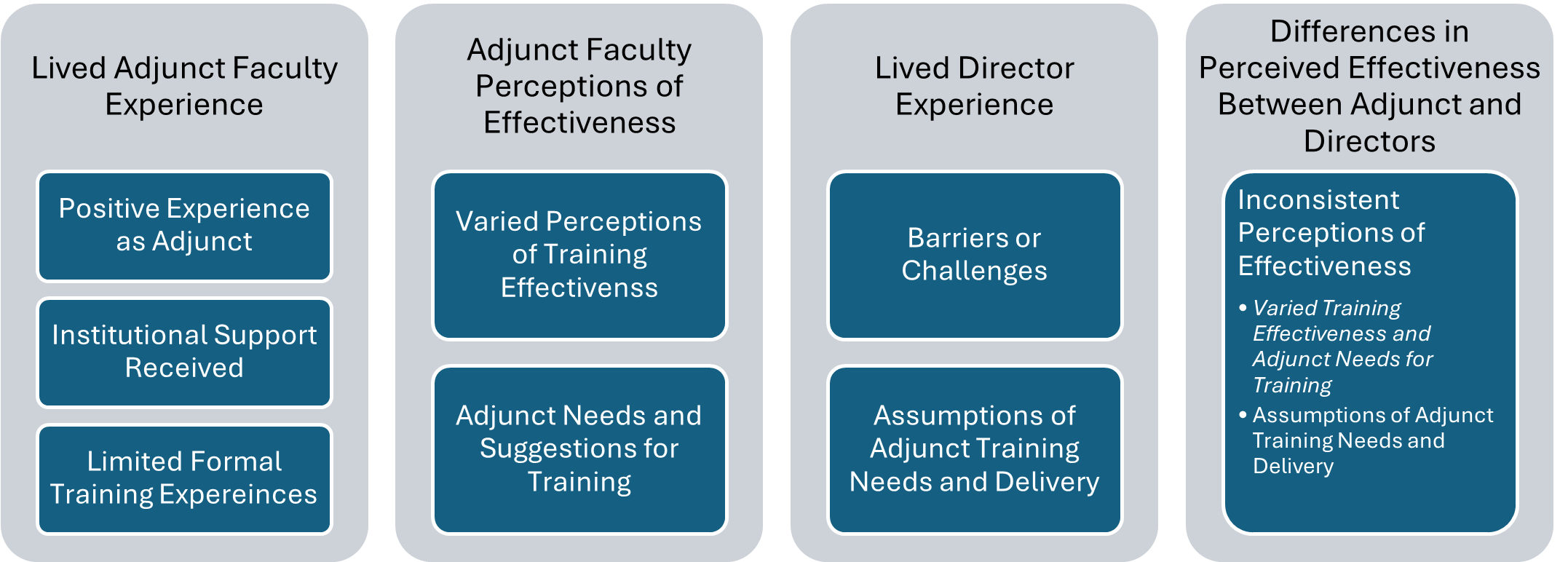
The study’s findings highlight the lack of formal, structured onboarding and professional development for adjunct faculty, especially at small institutions. Figure 1 displays the eight themes that emerged from the findings, including: (1) positive experiences as an adjunct, (2) institutional support received, (3) limited formal training experiences, (4) varied perceptions of training effectiveness, (5) adjunct needs and suggestions for training, (6) barriers or challenges for directors, (7) assumptions of adjunct training needs and delivery (8) inconsistent perception of effectiveness. Figure 2 shows the eight identified themes that emphasize the need for better training, clear expectations, ongoing support, and accessible communication.
Figure 1
Experience and Perception Findings
In addition to the interviews, the researcher distributed a survey to adjunct faculty for triangulation with the interview data and descriptive statistics purposes. Table 1 displays the responses to the survey. Of the participants who responded to the survey, the majority indicated a high level of perceived effectiveness in the received training, either onboarding or professional development opportunities, for influencing their preparedness to teach and satisfaction with teaching at the institutions. However, the interview responses indicated themes for which they could be prepared better or more thoroughly through orientation and ongoing training. The results indicate the varied experiences and perceptions that are further elaborated in the discussion of the themes.
Table 1
Adjunct Survey Results
| Question | Count | Percentage |
| Q2 - Did your onboarding experience influence your feelings of preparedness to teach your online courses? | ||
| Definitely | 7 | 47% |
| Probably | 5 | 33% |
| Unsure | 1 | 7% |
| Probably Not | 2 | 13% |
| Q3 - Has the professional development offered influenced your feelings of preparedness to teach your online courses? | ||
| Definitely | 6 | 40% |
| Probably | 3 | 20% |
| Unsure | 3 | 20% |
| Probably Not | 2 | 13% |
| Definitely Not | 1 | 7% |
| Q4 - The overall training you received from the institution influenced your overall satisfaction with teaching at this institution. | ||
| Strongly Agree | 2 | 13% |
| Agree | 8 | 53% |
| Undecided | 3 | 20% |
| Disagree | 1 | 7% |
| Strongly Disagree | 1 | 7% |
| Q5 - The overall training you received from the institution addressed the challenges or barriers you encountered as you prepared to teach remotely. | ||
| Strongly Agree | 3 | 20% |
| Somewhat agree | 9 | 60% |
| Neither agree nor disagree | 1 | 7% |
| Somewhat disagree | 1 | 7% |
| Strongly disagree | 1 | 7% |
Discussion
The research results uncovered challenges such as misalignment in training, barriers in workflow and timing, and the lack of awareness of the effectiveness of the training. Adjuncts reported that changes in leadership may contribute to breakdowns in systematic onboarding and professional development initiatives in addition to limited feedback loop opportunities. Despite the gaps, most participants indicated positive experiences and feeling supported by at least one key person or department. However, a lack of structured onboarding and limited professional development left many adjuncts feeling less prepared, confident, and invested in their teaching and technology use. The variation in perceptions highlights the challenge of developing structured training that meets all the needs and desires of an institution’s adjunct population.
Table 2 displays the emergent themes and codes in alignment with the four overarching research questions. The purpose of research question one was to explore the lived experience of adjunct faculty members during their onboarding process and professional development training opportunities at the university involved in the study, Site A or Site B. They were asked to describe their overall experience as an adjunct, their experience with any training programs, and how their experience has compared to other institutions if they have worked as an adjunct elsewhere. The purpose of research question two was to explore how adjunct faculty perceive the effectiveness of their onboarding training and professional development opportunities. They were asked to reflect on how their training experiences have influenced their teaching abilities and connectedness to the institution, examples of when they felt they did and did not receive need training and support, what specific types of training are needed, suggestions for improving the overall training and how this would change their experience. The purpose of research question three was to explore the lived experiences of directors in developing and implementing training for adjunct faculty. They were asked to describe their experience in their professional role with adjunct faculty in managing the training and the challenges or barriers they face in implementing comprehensive training. Research question four aimed to examine the gap or differences in how adjunct faculty perceived the effectiveness of training received compared to how directors perceived the effectiveness of training delivered.
Table 2
Emergent Themes, Relevant Codes, and Research Question Alignment
| Research Question | Relative Codes | Theme | ||
| RQ1. What is the lived experience of adjunct faculty members during the onboarding process and professional development training at a university? | Passion for teaching and students; Good Experience; Feel Supported/Connected; Appreciate Additional Income | Positive Experience as Adjunct | ||
| One-on-One Training/Meeting; Support of Department/key People; Importance of Technology and LMS Training; Courses/Workshops; Connecting with Peers; Knowing Who to Ask Questions | Institutional Support Received by Adjuncts | |||
| Limited Formal Onboarding; Limited Professional Development Opportunities; Self-initiated | Limited Formal Training Experiences by Adjuncts | |||
RQ2. How do adjunct faculty members perceive the effectiveness of their onboarding training and professional development? | Lack of Formal Onboarding; Lack of Professional Development Opportunities; Experience of Adequate Training; Importance of Connection/Support; Desire for More; Inconsistency in Delivery/Leadership; Feeling Isolated; Adjunct Teaching Competencies; Adjunct Desires for Role | Varied Perceptions of Training Effectiveness by Adjuncts | ||
| Technology and LMS Training; Clear Expectations and Communication; Connecting with Peers; Personalized/Relevant; Mentoring; Systematic Training; Understanding Program/Full Curriculum; Feedback; Earlier Access to Courses | Adjunct Needs and Suggestions for Training | |||
| RQ3. What is the lived experience of directors in developing and implementing training for adjunct faculty? | Limited Barriers; Varied Adjunct Teaching Experiences; Timing/Workflow | Barriers or Challenges for Directors | ||
| Create Sense of Belonging; Technology and LMS Training; Personalized/Relevant; Program Orientation | Assumptions of Adjunct Training Needs and Delivery by Directors | |||
| RQ4. What differences exist in how directors perceive the effectiveness of their training initiatives compared to adjunct faculty members? | Lack of Formal Onboarding; Lack of Professional Development Opportunities; Experience of Adequate Training; Importance of Connection/Support; Desire for More; Inconsistency in Delivery/Leadership; Feeling Isolated; Adjunct Teaching Competencies; Adjunct Desires for Role; Technology and LMS Training; Clear Expectations and Communication; Connecting with Peers; Personalized/Relevant; Mentoring; Systematic Training; Understanding Program/Full Curriculum; Feedback; Earlier Access to Courses | Inconsistent Perceptions of Effectiveness from Adjuncts and Directors: Varied Perceptions of Training Effectiveness by Adjuncts and Adjunct Needs for Training by Directors | ||
| Create Sense of Belonging; Technology and LMS Training; Personalized/Relevant; Program Orientation | Assumptions of Adjunct Training Needs and Delivery | |||
Theme 1: Positive Experience as Adjunct
Most adjuncts reported a broadly positive experience, driven by a passion for teaching, student impact, and the flexibility to keep full-time roles. Feeling connected to departments and having approachable contacts reduced the isolation sometimes felt by off-campus or online instructors. Triangulation supported this: institutional messages conveyed a collegial tone, and 66% of survey respondents agreed training influenced overall satisfaction.
Theme 2: Institutional Support Received by Adjuncts
Participants reported varied and sometimes inconsistent support across time and leaders at their employing institution. All received some LMS onboarding via 1:1 help or an online course, with additional workshops offered intermittently. Ongoing help often came through clear individual pathways, email reminders, ITS assistance, and occasional peer connections. Knowing whom to contact (department leads, ITS) was pivotal; however, opportunities for peer connection varied by site, reflecting the inconsistency noted in prior literature.
Theme 3: Limited Formal Training Experiences by Adjuncts
Many adjuncts characterized formal onboarding and PD as limited or self-initiated, often receiving only operational basics such as grading timelines or FERPA information. Competing work demands and late course access further reduced participation. Archival training example materials collected indicated that resources existed, but outreach and cadence were inconsistent. In the survey, about 60% reported PD influenced preparedness, demonstrating the gap between availability and effectiveness.
Theme 4: Varied Perceptions of Training Effectiveness by Adjuncts
Perceptions ranged from “adequate with strong informal support” to “insufficient and isolating,” often shaped by prior experience and leadership changes. Comparisons to other institutions were mixed. Lead-time constraints were common. Triangulation of survey results reflected the split: with about 80% felt onboarding prepared them, 66% said training affected satisfaction, yet 48% reported lacking onboarding/PD.
Theme 5: Adjunct Needs and Suggestions for Training
The theme aligns with findings in the literature on the importance and often lack of understanding of adjunct faculty's specific needs (Butters & Gann, 2022; Harwood & Koyama, 2021; Hurtienne et al., 2022). Top needs centered on robust LMS/technology preparation, clear expectations, identifiable support pathways, and earlier course access. Participants also asked for systematic, program-aligned onboarding/PD, a centralized resource hub, peer community/mentoring, and opportunities to provide feedback on courses. Survey patterns aligned with these priorities, with 64% of participants emphasizing technology/LMS, and 56% sought clearer expectations.
Theme 6: Barriers or Challenges for Directors
Directors reported few specific barriers but acknowledged workflow complexity, short hiring windows, and wide variability in adjunct backgrounds. Unclear cross-unit processes, such as understanding who owns which part of onboarding, created friction or uncertainty. These conditions align with current literature highlighting the need for more structured, coordinated onboarding and PD that can scale despite timing constraints.
Theme 7: Assumptions of Adjunct Training Needs by Directors
Directors emphasized LMS/technical orientation and fostering belonging through personalized, flexible touchpoints with either 1:1 sessions or larger group program orientation. They suggested earlier course access, stronger cross-department coordination, and mentoring, while acknowledging limited visibility into institution-wide onboarding content.
Theme 8: Inconsistent Perceptions of Effectiveness from Adjuncts and Directors
A clear perception gap emerged: directors generally believed training was effective, while adjuncts reported mixed results and limited formal feedback channels. Both groups valued technology/LMS support and community-building; however, adjuncts linked clearer, timelier, and more comprehensive training to increased confidence, efficiency, and teaching quality. Triangulation with surveys contextualized this tension (80% felt prepared, 66% satisfied with the influence of training on their teaching, 48% felt their experience lacked onboarding/PD opportunities).
Conclusion and Implications
The study affirms the importance of structured orientation practices and ongoing learning opportunities for adjuncts, as highlighted in the existing literature. The findings suggest that effective adjunct support requires addressing adjunct faculty's varied and often unmet needs, particularly through tailored, continuous training and clear communication. Administrative actions to outline the departments and roles that indicate appropriate ownership of the onboarding steps. Interviews with both faculty and academic administrators reveal that a one-size-fits-all approach to training is insufficient and that personalized, consistent feedback loops are necessary for enhancing faculty engagement, satisfaction, and teaching effectiveness. Distance education directors or academic affairs leaders could take action to outline the process, expectations, and procedure of the training, either at the policy level or by documenting guidelines.
The results of the study indicate that challenges to developing comprehensive training involve the diverse types and needs of adjunct faculty working for an institution and a lack of greater mapping of their orientation journey in the institution, including listening mechanisms for gauging the effectiveness of current practices. For practical implications, the study emphasizes that academic affairs leaders and distance education directors can improve adjunct faculty experiences by designing onboarding and professional development programs that are reflective, relevant, and applied to real teaching situations. This aligns with adult learning and experiential learning theories, which stress the importance of reflection, hands-on experience, and social interaction in fostering professional growth.
The research also uncovered barriers such as misaligned training, issues with timing and workflow, and a lack of awareness regarding training effectiveness that could be improved with feedback strategies and documented timing standards for hiring and course assignment. Many adjuncts noted that leadership changes might contribute to disruptions in consistent onboarding and professional development alongside limited feedback opportunities. Given this finding, documenting workflow procedures and standards in policy or guidelines is recommended. Despite these challenges, most participants reported positive experiences and feeling supported by at least one key person or department, which promotes the benefit of continuing to hire and adequately support adjunct faculty. The absence of structured onboarding and professional development left many adjuncts feeling less prepared, confident, and engaged in their teaching and technology or Learning Management System use. The study offers strategies for academic affairs leaders, chief online officers, and distance education directors, emphasizing the importance of establishing clear expectations, fostering relationships between faculty and administrators, and providing regular opportunities for faculty development. This approach could ultimately enhance faculty retention and student engagement. Although this study was conducted at two small liberal arts institutions, many of the findings are highly transferable across institutional types and sizes, public or private, including standardizing workflows, timing, communication, and feedback procedures. Findings that may be context-specific could depend on the type of adjunct faculty population, such as instructors without any teaching background or experience, course creation practices and use of LMS. Institutions with more established distance learning delivery policies or guidelines may read the suggestions as confirmation rather than as actions to take.
Experiential Learning Theory
The study findings and current literature suggest that elements of experiential learning theory were sometimes present within participants’ training experiences and that training programs would benefit from intentional integration. The theory emphasizes learning through experience and reflection (Xin et al., 2019), aligning with participants who received personalized, hands-on LMS training. Such active engagement supported learning more effectively than self-paced or static instruction. Participants noted that earlier access to courses and just-in-time training would have deepened understanding and reduced information overload. Collaborative activities, such as peer work sessions, further reflected experiential principles.
However, the application of experiential learning across institutions was inconsistent. While some directors incorporated experiential methods through personalized meetings, others lacked structured approaches. Participants frequently expressed that limited training hindered their sense of belonging and readiness. These findings support the literature that integrating experiential learning more deliberately into onboarding and professional development could enhance engagement and effectiveness (Farakish et al., 2022; Harwood & Koyama, 2022).
Adult Learning Theory
Adult learning theory underscores the importance of collaboration, self-direction, and relevance to learners’ professional experiences (Burleigh et al., 2021; Witcher & Sasso, 2022). The study and literature suggest that professional development programs based on theories of adult learning are more collaborative, better integrated into an institution’s culture, and promote continuous learning with a greater degree of transferring learning (Burleigh et al., 2021; Ward & Lin, 2022; Witcher & Sasso, 2022). Participants valued experiences reflecting these principles, such as peer meetups and workshop-style training that emphasized shared practice. These opportunities fostered professional community and practical application, aligning with the theory’s focus on experiential, problem-centered learning.
Yet, participants noted inconsistent implementation and irregular scheduling of professional development, limiting its sustained impact. The findings suggest that embedding adult learning theory into regular, interactive training could promote ongoing engagement and better transfer of learning to adjunct teaching contexts (Ward & Lin, 2022).
Recommendations for Further Study
This study examined a specific subset within higher education defined by institution size, type, and location. The researcher sought to advance knowledge by exploring lived experiences with training and perceptions of effectiveness among this group. The study compared adjunct faculty and academic leaders at two universities, generating rich insights primarily from adjunct participants. Future research could focus on specific leadership roles and purview, such as distance education department leaders, deans, or associate provosts, or include multiple universities to compare public and private institutions.
Both participating universities offered a limited portfolio of fully online programs, mainly in education. Further studies could explore adjunct faculty across disciplines or professional backgrounds, as prior teaching experience influenced participants’ needs for online teaching support. Given the growth of online programs (Butters & Gann, 2022), research could also examine in-person adjunct faculty or compare those retired from full-time roles with those balancing full-time employment and adjunct work. Participants described varied experiences with receiving pre-built course shells or developing their own courses. Future studies might investigate different course development models, teaching expectations, and program structures to broaden understanding of online faculty practices and address areas beyond this study’s scope.
References
Aguilera, S. E., & Martinez, E. (2023). Average or outlier? Introductory statistics adjunct instructors' beliefs, practices, and experiences. The Qualitative Report, 28(6), 1769-1786. https://doi.org/10.46743/2160-3715/2023.5971
Barnes, A., & Fredericks, E. (2021). A diamond in the rough: adjunct faculty opportunities and challenges in higher learning institutions. Journal of Higher Education Theory and Practice, 21(7), 83-102. https://www.proquest.com/scholarly-journals/diamond-rough-adjunct-faculty-opportunities/docview/2572622896/se-2
Buch, K., McCullough, H., & Kapota, J. (2023). Virtual faculty learning communities: An innovative approach to supporting adjunct faculty. The Journal of Faculty Development, 37(1) https://www.proquest.com/scholarly-journals/virtual-faculty-learning-communities-innovative/docview/2760887042/se-2?accountid=15017
Burleigh, C., Steele, P. B., & Gwitira, G. (2021). Online adjunct faculty perceptions of professional development to support personal and professional academic growth during COVID-19. Higher Learning Research Communications, 11(2) https://www.proquest.com/docview/2859206210?accountid=12085&sourcetype=Scholarly%20Journals
Butters, D., & Gann, C. (2022). Towards professionalism in higher education: An exploratory case study of struggles and needs of online adjunct professors. Online Learning (Newburyport, Mass.), 26(3), 259. https://doi.org/10.24059/olj.v26i3.2801
Cheslock, J. J., & Jaquette, O. (2022). Concentrated or fragmented? the U.S. market for online higher education. Research in Higher Education, 63(1), 33-59. https://doi.org/10.1007/s11162-021-09639-7
Creswell, J. W. & Poth, C. N. (2018). Qualitative inquiry & research design: Choosing among five approaches (4th ed.). Thousand Oaks, CA: Sage Publications
Dyer, L. T., & Song, L. (2023). Professional development for online faculty: Supporting conceptual change through conceptual conflict activities. The Journal of Faculty Development, 37(3), 20-27. https://www.proquest.com/scholarly-journals/professional-development-online-faculty/docview/2858412162/se-2
Farakish, N., Cherches, T., & Zou, S. (2022). Faculty success initiative: An innovative approach to professional faculty onboarding and development. Journal of Formative Design in Learning, 6(2), 113-126. https://doi.org/10.1007/s41686-022-00069-x
Frankel, A. S., Friedman, L., Mansell, J., & Ibrahim, J. K. (2020). Steps towards success: Faculty training to support online student learning. The Journal of Faculty Development, 34(2), 23-32. https://www.proquest.com/scholarly-journals/steps-towards-success-faculty-training-support/docview/2478112391/se-2?accountid=15017
Frögéli, E., Jenner, B., & Gustavsson, P. (2023). Effectiveness of formal onboarding for facilitating organizational socialization: A systematic review. PloS One, 18(2), e0281823. https://doi.org/10.1371/journal.pone.0281823
Laws, G. (2021). Powerful or powerless? chief online education officers’ legitimate power over online program quality in U.S. higher education institutions. Online Learning (Newburyport, Mass.), 25(2), 120. https://doi.org/10.24059/olj.v25i2.2101
McAtee, B., & Huston, R. (2023). Finding Innovative Strategies to Enhance Adjunct Faculty Support and Retention. Journal of Nursing Education, 1-4. https://doi.org/10.3928/01484834-20230315-02
Mellieon, J.,Harold I., & Robinson, P. A. (2021). The new norm: Faculty perceptions of condensed online learning. The American Journal of Distance Education, 35(3), 170-183. https://doi.org/10.1080/08923647.2020.1847626
Moustakas, C. (1994). Phenomenological Research Methods. SAGE.
Murray, D. S. (2019). The precarious new faculty majority: Communication and instruction research and contingent labor in higher education. Communication Education, 68(2), 235-245. https://doi.org/10.1080/03634523.2019.1568512
Rahman, Z. G., Murray, E., & Golnabi, A. H. (2021). Adjunct mathematics instructor resources and support contributing toward job satisfaction. PRIMUS: Problems, Resources, and Issues in Mathematics Undergraduate Studies, 31(10), 1021-1037. https://doi.org/10.1080/10511970.2020.1805660
Saldana, J. (2021). The Coding Manual for Qualitative Researchers (4th ed.). Sage.
Sim, C. L., Wong, T. A., Sin, K. Y., & Sivakumaran, V. M. (2024). Pragmatism as a paradigm for quality management research in bridging academic-practitioner gaps. International Journal of Quality and Service Sciences, 16(2), 330-342. https://doi.org/10.1108/IJQSS-07-2024-192
Smith, C. E., Matthews, R. A., Mills, M. J., Yeong-Hyun, H., & Sim, S. (2022). Organizational Benefits of Onboarding Contingent Workers: An Anchoring Model Approach. Journal of Business and Psychology, 37(3), 525-541. https://doi.org/10.1007/s10869-021-09757-0
Ward, P., & Lin, H. C. (2022). Design and implementation of a program development practicum for faculty education and advancement of clinical programs. Pediatric Reports, 14(4), 457-463. https://doi.org/10.3390/pediatric14040054
Witcher, S. D., & Sasso, P. A. (2022). A comparison of generational differences in faculty perceptions of online versus face-to-face professional development - A community college case study. College Teaching, ahead-of-print, 1-12. https://doi.org/10.1080/87567555.2022.2124394
Xin, P. V., Wong, L., Chen, W., & Chee-Kit Looi. (2019). Principled practical knowledge in bridging practical and reflective experiential learning: case studies of teachers’ professional development. Asia Pacific Education Review, 20(4), 641-656. https://doi.org/10.1007/s12564-019-09587-z
Yin, R. K. (2018). Case study research and applications: Design and methods (6th ed.). Thousand Oaks, CA: Sage Publications.
Young-Brice, A., Farrar-Stern, K., & Malin, M. (2022). Comprehensive Onboarding and Orientation to Support Newly Hired Faculty in a Nursing Program. Nurse Educator, 47, 347-351. https://doi.org/10.1097/NNE.0000000000001242